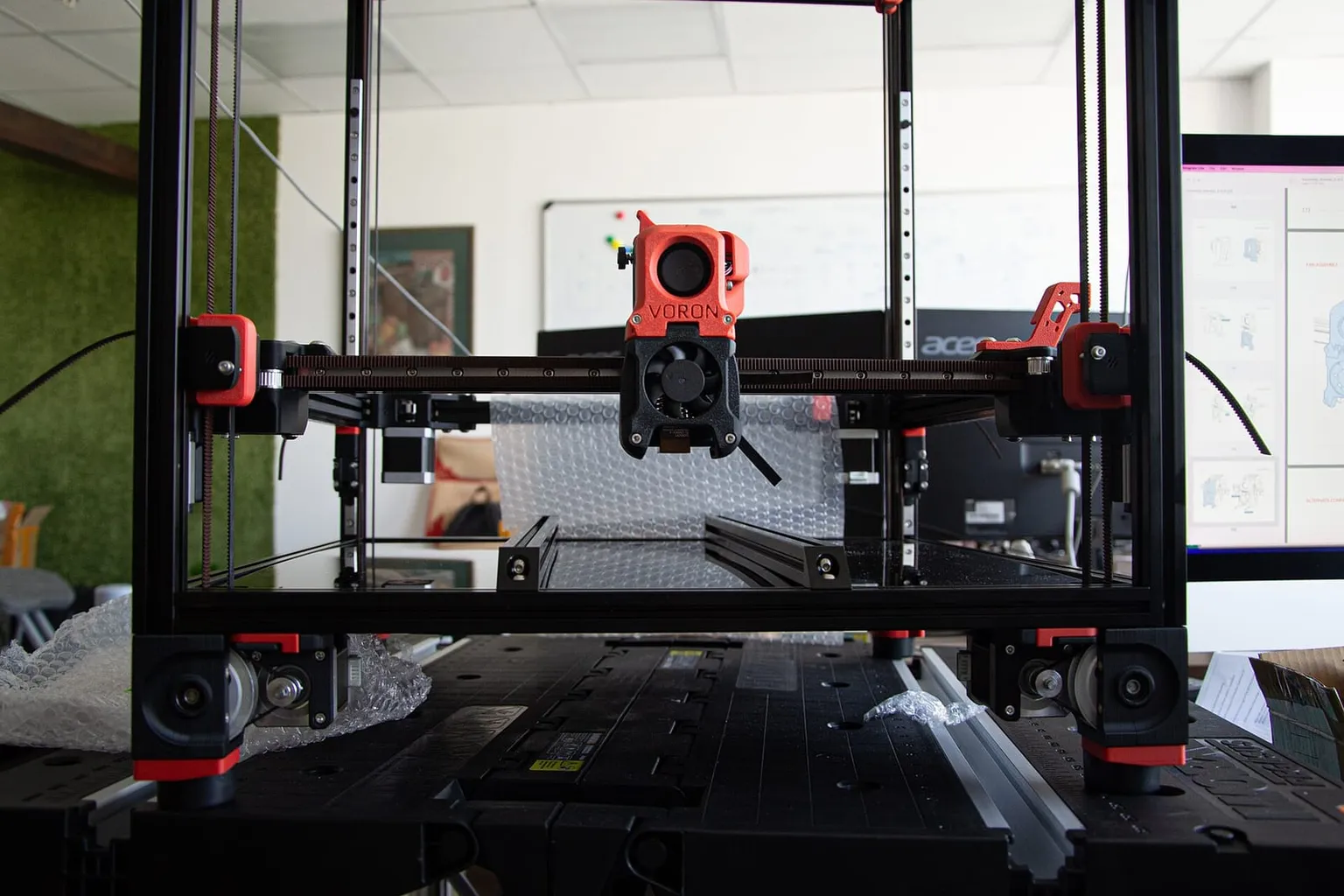
A Voron is an open-source, enclosed CoreXY printer you build yourself, designed from the start for ABS. That makes it a strong base for engineering materials up to nylon and PC. This page covers the models, what their chambers reach, the limits the design sets, and the upgrades that fit.
A Voron is an open-source 3D printer you build from a published bill of materials or a third-party kit. Every current model is enclosed, and Voron designed its parts around ABS. Its chamber “generally” reaches 50 to 60 °C without a heater, which Voron calls “perfect for printing ABS and most Nylon and PC blends.” PEEK and PEI are beyond what the design supports.
What is a Voron 3D printer?
Voron is a project, not a company that sells printers. Its documentation says “all Voron designs are Open Source”, with CAD, STL files and manuals on GitHub. The project began in 2015 to build “a no-compromise 3D printer that was fun to assemble and a joy to use.” You either source the parts yourself using Voron’s guides, or buy a kit. Voron “does not implicitly endorse any specific vendor of Voron kits.”
All current Vorons use CoreXY or CoreXZ motion, and Voron states that “all printers (except Legacy) are capable of being fully enclosed to print ABS”. Builders can request a serial number by posting a video of the finished printer on the Voron subreddit, with safety features such as a “deck plate or electronics separate from chamber”.
Voron models compared
Voron’s current line has three models. They differ in size and in how the bed and gantry move. Voron’s own build-cost estimates give a sense of the spread.
| Model |
Build volume |
Motion |
Voron’s build-cost estimate |
| Voron 0.2 |
120 x 120 x 120 mm |
CoreXY, bed moves in Z |
$400 to $600 |
| Voron Trident |
250, 300 or 350 mm square, 250 mm tall |
CoreXY, fixed gantry, 3-point bed moves in Z |
$1,000 to $1,300 |
| Voron 2.4 (V2.4r2) |
250 x 250 x 220 mm up to 350 x 350 x 330 mm |
CoreXY, static bed, gantry moves in Z |
$1,500 to $1,900 |
Voron 0.2 vs 2.4 for engineering materials
Both are enclosed and both print ABS. The difference for engineering materials is size and bed power. The 0.2 uses a 24 V DC bed, “Silicone DC 24V Heater 100x100mm 60W” in Voron’s sourcing guide, while the 2.4 uses a mains-powered AC heater. For large parts in warp-prone materials, the 2.4’s larger mains-powered bed is the more practical base.
Why do people build Vorons for ABS printing?
Because the whole design assumes ABS. Voron says “the parts have been designed with ABS/ASA shrinkage in mind”, and recommends ABS as “the primary recommended material for Voron printers due to the high temperature rating and moderate ductility”. The enclosed frame traps heat from the bed, and Voron says chambers commonly reach 55 to 60 °C, which suits ABS.
Voron chamber temperature: what to expect
Expect 50 to 60 °C. Voron’s sourcing guide says “chamber temperatures generally do not exceed 50-60C”, and its materials guide calls 55 to 60 °C common. That comes from the bed alone, because no Voron includes a chamber heater. Voron says that range is “insufficient for exotic materials such as PEEK and PEI which require 100-130C chamber temperatures.”
What can a Voron print that other printers can’t?
Compared with open-frame printers, a Voron’s 50 to 60 °C chamber lets it print ABS and ASA. By Voron’s account, it also handles most nylon and PC blends. Compared with enclosed consumer printers with active heating, it is similar: Bambu Lab’s X1E reaches 60 °C with a heater. What sets a Voron apart is that you choose and can change every part, including the hotend and electronics.
Where a Voron’s limits sit
A Voron’s limits come from the parts Voron specifies, and the docs state them plainly. The printed parts need a material with a glass temperature “at least 80 ºC”. Voron warns that “most of the parts in your Voron printer will fail before 100C including: all of the 3D printed components, stepper motors, Gates belt, linear bearings”. Its wiring guide adds: “Don’t run your bed above 110°C”, because heat shortens the life of the heater’s adhesive.
| Part |
Voron’s stated limit |
| Chamber (no heater) |
Generally 50 to 60 °C |
| Printed parts |
Material with a glass temperature of at least 80 °C; ABS or ASA recommended |
| Printed parts, motors, belts, bearings |
“Will fail before 100C” |
| Bed |
Do not run above 110 °C |
How to upgrade a Voron for high-temp printing
Upgrade the hotend first, because it is the easiest limit to move and the toolhead supports several. Above that, the chamber and bed limits come from the design itself. Voron does not support active chamber heating, and running past the limits above is outside it.
- Hotend. Fit one rated for your material, with a matching sensor and firmware maximum.
- Firmware. Set the sensor type and raise the hotend maximum in Klipper.
- Bed. Stay at or below the 110 °C Voron recommends for its heater adhesive.
- Chamber. A third-party heater can add heat. Check every part in the chamber against its rating first.
How to pick a Voron hotend for engineering filaments
Pick from the hotends Voron’s Stealthburner toolhead supports, then choose a version rated for your material. Voron’s printhead compatibility list includes the Chube Compact, Phaetus and Trianglelab Dragon, Phaetus BMO, BMS and Rapido, and E3D Revo Micro, Revo Six, V6 and Revo Voron. E3D’s Revo High-Temperature Hotside lists Voron among its fits, rated to 500 °C with a PT100 or PT1000 sensor.
The hotend guide compares high-temperature hotends and the sensors and heaters each needs.
How to spec a Voron build for high-temp printing
Start from Voron’s own sourcing guide, then choose the high-temperature options at the points it allows. Use ABS or ASA for printed parts, as Voron requires. Pick a supported hotend in a high-temperature version, and plan the bed heater and power for your mains supply. The Voron bed power guide covers sizing the heater.
Adding a chamber heater to a Voron
Voron does not support it. Its sourcing guide says “Voron does not and will not support active chamber heating”, and warns: “If we spec something and people cheap out, there will be fires involved.” It also states a heater is “not necessary” for ABS. A heater only makes sense for materials that need more than 50 to 60 °C, within the part limits above.
Commercial heaters with a Voron fit are scarce. BIGTREETECH’s wiki says its Panda Breath supports Klipper printers including Voron, and that Klipper printers “currently requires manual heating control”. The Klipper chamber heater guide covers wiring one into Klipper as a generic heater, with verification left on.
Voron chamber heater kit options
Voron publishes no chamber heater design or kit, and we found no Voron-specific commercial kit. The general-purpose retrofit heaters are listed in the chamber heater comparison, with their ratings and fits. Any of them on a Voron is outside the design, so check the printed parts, motors and belts against the temperatures above.
Voron kits
A kit gathers the sourced parts in one box. Voron does not endorse any vendor. The listings below are examples with their prices on October 1, 2026, not a comparison of quality.
| Kit |
Seller |
Size |
Price |
| Voron 2.4 R2 Ultra kit |
Formbot |
250 mm |
$739.00 |
| Voron 2.4 R2 Ultra kit |
Formbot |
350 mm |
$839.00 to $904.00, by hotend |
| LDO Voron 2.4 R2 (Rev D+) kit |
Fabreeko |
300 mm |
$1,299.99; listed as unavailable |
| LDO Voron 2.4 R2 (Rev D+) kit |
Fabreeko |
350 mm |
$1,399.99; listed as unavailable |
Formbot’s prices change with the shipping origin selected. Kit contents differ, so compare each against Voron’s bill of materials before buying.