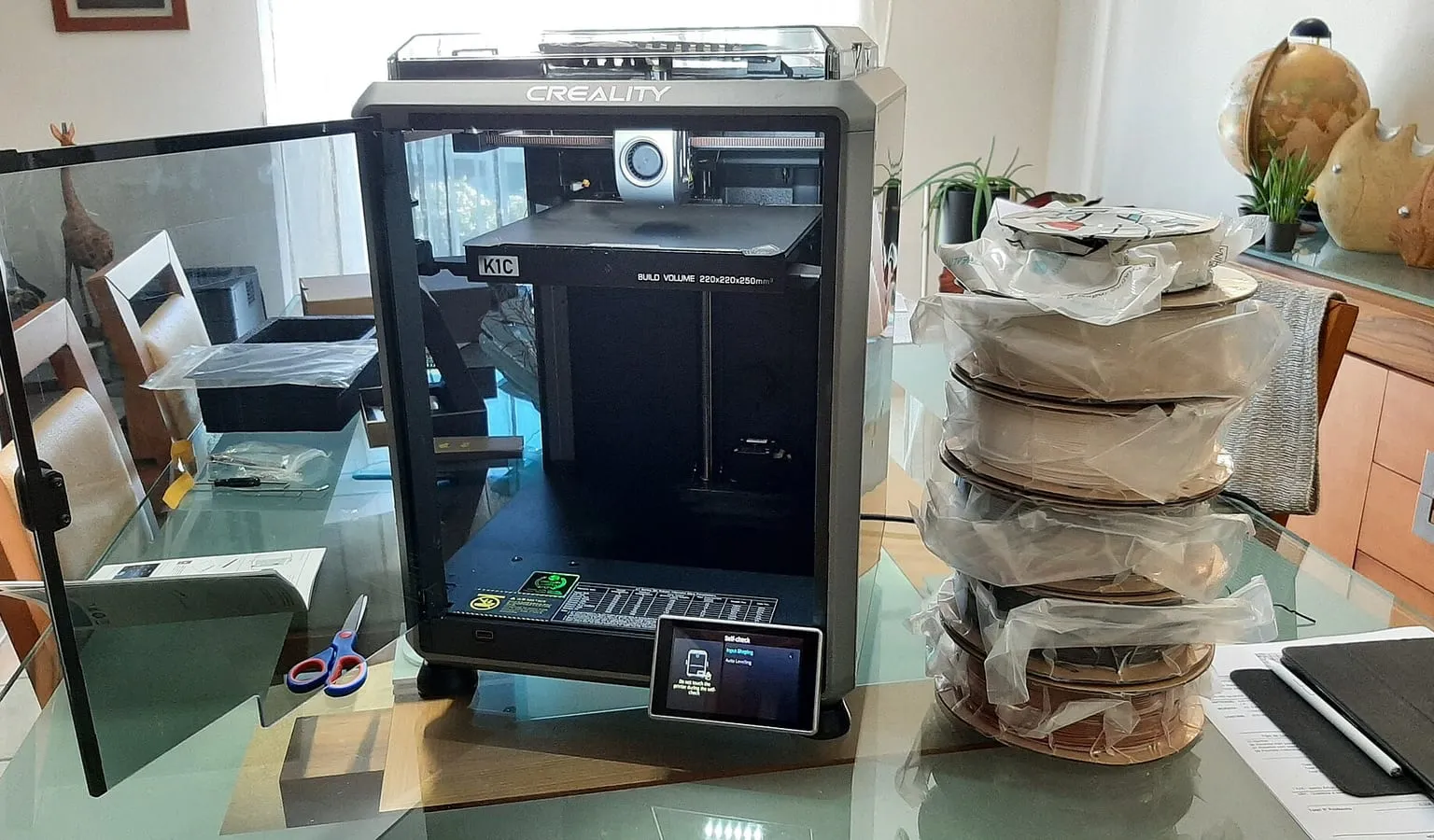
A chamber heater holds the air around a print at a set temperature, which reduces warping and layer splitting in engineering materials. Retrofit kits exist for many enclosed printers, but they stress parts that were not chosen for the heat, and most printer makers do not support them. This page explains how they work, what they are for, and every retrofit kit we could verify.
Yes, you can add a chamber heater to most enclosed 3D printers. A retrofit kit mounts inside the enclosure, warms the air with an electric heater, and holds it at a set temperature. Most kits we found stop at 60 to 70 °C, and one goes higher on specific printers. An open-frame printer needs an enclosure first, because a heater cannot hold temperature in open air.
How does a chamber heater work in a 3D printer?
A chamber heater blows air across a heating element and regulates it against a temperature sensor in the chamber. Most retrofit kits use PTC (positive temperature coefficient) ceramic elements. TDK, which makes them, explains that heat raises the element’s resistance, “thereby limiting the current and establishing a stable equilibrium.” That self-limiting behavior is the main reason PTC elements are used.
The control side varies. Some kits run their own thermostat, some take setpoints from a phone or web interface, and printers running Klipper can drive a heater as a generic heater. The Klipper chamber heater guide covers that setup.
What does a chamber heater do for print quality?
Warm chamber air keeps the printed part closer to its printing temperature, so its layers cool and shrink less unevenly. Bambu Lab’s filament guide says ABS, ASA, PC, PA and their filled grades “require higher heatbed and chamber temperatures to suppress warping and layer separation”. Less warping means fewer lifted corners and less splitting between layers on tall parts.
What materials need an aftermarket chamber heater?
Materials that print best in a chamber above what an enclosure reaches passively need one. Bambu Lab’s X1E FAQ recommends a 60 °C chamber for “PC, PA-CF, PAHT-CF, PET-CF, PPA-CF, PPS, and PPS-CF”. PEKK and PEI need more: 3DXTECH recommends 70 to 150 °C for its PEKK-A, and Fiberlogy asks for “Enclosed chamber: >80°C” for its PEI 9085.
ABS is the main material that usually does not need one. Voron’s documentation states that “it is not necessary to use a chamber heater to achieve sufficient chamber temperatures for ABS or other common 3D printing materials”. It adds that chamber temperatures “generally do not exceed 50-60C”.
Do I need a chamber heater for nylon and PC?
For filled nylons and PC, it helps. Bambu Lab sets 60 °C for both on the X1E, its printer with active chamber heating. An enclosed printer without a heater warms only from the bed, so its chamber may sit below that. A heater is most useful on large or tall parts, where warping is worst.
Is a chamber heater upgrade worth it for ABS and nylon?
For ABS, rarely. Voron’s guidance is that a heater is not necessary for ABS, and enclosed printers print it stock. For carbon-filled nylon, a heater brings the chamber to the 60 °C Bambu Lab recommends, which matters most on parts that warp. Weigh that against the warranty and the extra heat on the printer’s parts, covered below.
What chamber temperature can a retrofit heater reach?
Most retrofit kits on sale stop between 60 and 70 °C. BIQU and MartilloTech list 60 °C for their Bambu Lab heaters, and Creality lists 45 to 70 °C for its standalone heater. Tyson Build lists 85 to 105 °C for the Tyson Hat, depending on the printer. The temperature a kit reaches also depends on how well the enclosure is sealed and insulated.
For comparison, printers with built-in active chamber heating list similar ceilings: 55 °C for the Prusa CORE One+, 60 °C for the Creality K2 Plus and Bambu Lab X1E, and 65 °C for the Bambu Lab H2D and QIDI Plus5.
Chamber heater retrofit kits compared
The table lists every commercial retrofit chamber heater we could verify on its seller’s own page, sorted by the maximum chamber temperature the seller states. It is not a ranking. Prices are as listed on October 1, 2026, and several change by warehouse or region.
| Heater |
Seller |
Heater type |
Power |
Stated chamber maximum |
Control |
Printers listed |
Price |
| MartilloTech X1C Chamber Heater |
Call3D |
Not stated |
300 W |
40 to 60 °C |
Toolhead sensing, automatic on and off |
Bambu Lab X1, X1C |
$129.99 (110 V), $139.99 (220 V); sold out |
| MartilloTech P1S Chamber Heater |
Call3D |
Not stated |
300 W |
40 to 60 °C |
Toolhead sensing, automatic on and off |
Bambu Lab P1 series |
$129.99; sold out |
| MartilloTech P2S Chamber Heater M2 |
Call3D |
PTC |
300 W rated |
40 to 60 °C |
Automatic and manual modes |
Bambu Lab P2S |
$129.99 |
| BIQU Panda Breath |
BIQU |
PTC |
300 W |
60 °C |
Wi-Fi web interface |
Bambu Lab X1C, P1S, P1P, A1, A1 mini; Klipper printers with manual control |
$87.12 (US warehouse) to $145.00 (China) |
| Creality Chamber Heater |
Creality |
PTC |
400 W |
45 to 70 °C |
Standalone temperature controller |
Not stated |
€99.99 (EU store) |
| Tyson Hat |
Tyson Build |
Not stated |
Not stated |
85 to 105 °C, by printer (see below) |
Web interface only |
Bambu Lab P2S, X2D; Elegoo Centauri Carbon; Prusa CORE One, CORE One L; QIDI Q2, Plus4, Max4; Sovol SV08 MAX |
$399 to $699, by printer |
| Sovol chamber heating module |
Sovol |
Not stated |
Not stated |
Not stated |
Not stated |
Sovol SV08 MAX |
$69.00 |
| DIY heater with thermostat |
Self-built |
Varies |
Varies |
No rating |
Thermostat or firmware |
Any enclosure |
Parts only |
Tyson Build lists its ratings per printer: “up to 100°C/105 °C on Bambu Lab P2S and X2D printers, 85 °C on the Elegoo Centauri Carbon and Prusa Core one/L, 100 °C on Qidi and Sovol machines.” The same page notes chamber temperatures “up to 65 °C (Printer Manufacturer recommended)”, says running above 65 °C “is done entirely at the user’s own risk”, and recommends XY motor insulation above 80 °C on Elegoo, Prusa, QIDI and Sovol machines. Control is through the heater’s own web interface, with no slicer integration.
BIGTREETECH’s wiki lists the Panda Breath’s PTC element limit as 105 °C and its maximum chamber temperature as 60 °C, and says Klipper printers currently need manual heating control. We found no commercial retrofit kit from Voron, LDO, Fysetc or Prusa.
PTC chamber heater vs DIY heat lamp: which is better?
A PTC heater is the safer choice for a printer enclosure, because its element limits its own temperature. A heat lamp or bulb does not, and its surface runs very hot. The US Consumer Product Safety Commission measured “a 150 watt incandescent bulb” at “about 340 degrees Fahrenheit” (about 171 °C). Printed ABS softens far below that: Polymaker lists a glass transition of 101 °C for its PolyLite ABS.
| Heater type |
How it limits its temperature |
Main risk |
| PTC ceramic element |
Resistance rises with heat and cuts the current |
The air around it still needs a thermostat |
| Incandescent bulb or heat lamp |
Only by an external thermostat |
Very hot surface near plastic parts and filament |
| Resistive coil or cartridge |
Only by an external thermostat |
Runaway if the control or sensor fails |
Voron’s documentation puts the DIY risk bluntly: “If we spec something and people cheap out, there will be fires involved.”
The housing matters because it sits inside the heat it creates. Few sellers state the material. Tyson Build describes the Tyson Hat as having an all-metal in-chamber structure with its electronics box on top. Sovol warns users not to “touch the metal parts on its surface”. If a heater’s housing is plastic, check that its rating sits well above your chamber target.
Are chamber heater retrofits safe?
They can be, within limits, but they push the printer’s own parts past what they were chosen for. Voron’s documentation warns that “most of the parts in your Voron printer will fail before 100C including: all of the 3D printed components, stepper motors, Gates belt, linear bearings”. Makers that build heating in stop at 55 to 65 °C, and retrofits above that are at your own risk.
Creality, which sells a retrofit heater, warns that “long-term operation of the chamber heater may affect the machine’s service life and even cause damage.” Heat also affects the filament path. Bambu Lab recommends keeping an enclosure “at least 10 degrees lower than the glass transition temperature of the filament”, because heat buildup is the most common cause of extruder clogs on the X1 Carbon and P1S.
How to protect electronics when adding a chamber heater
Keep the electronics out of the heated air, and cool what has to stay inside. For an overheating mainboard, Prusa Research advises that “if the printer is inside an enclosure, place it outside the enclosure to help reduce the measured temperature from the boards.” Its Core One pauses the print if “Chamber temperature above safety limit”.
- Mainboard and power supply: outside the chamber, or in a ventilated bay with its own fan.
- Stepper motors: insulate them or reduce their current at high chamber temperatures. Tyson Build recommends XY motor insulation above 80 °C on several printers.
- Wiring and printed parts: check their ratings against the chamber target.
- Filament path: keep low-temperature filament out of a hot chamber, and the chamber below the filament’s glass transition minus 10 °C, per Bambu Lab.
Why retrofit a chamber heater instead of buying a new printer?
A retrofit costs less than a new printer and keeps the machine you know, but most makers do not support it. A printer with built-in heating comes with a warranty that covers it. The Bambu Lab H2D and QIDI Plus5 heat their chambers to 65 °C stock. The upgrade versus industrial comparison prices both routes.
Check the warranty before buying. Bambu Lab states that its X1, X1C and P1 series do not support its chamber heating module, and most warranties exclude damage from third-party accessories. The warranty guide quotes the policies.
Aftermarket chamber heater vs stock enclosure
A stock enclosure is passive: it traps heat from the bed but adds none. Prusa Research describes its MK4/S enclosure as “Passive, heating provided only by the 3D printer’s heatbed”. A chamber heater adds active heat and holds a setpoint. For ABS, the enclosure is usually enough. For the 60 °C materials and above, it is not.