What Klipper macros can do
A Klipper macro is your own G-code command, written in the printer config. This page explains how macros work, what Klipper does and does not ship, and the macros most printers end up running, with a link to the page that covers each one.
Published · Last verified
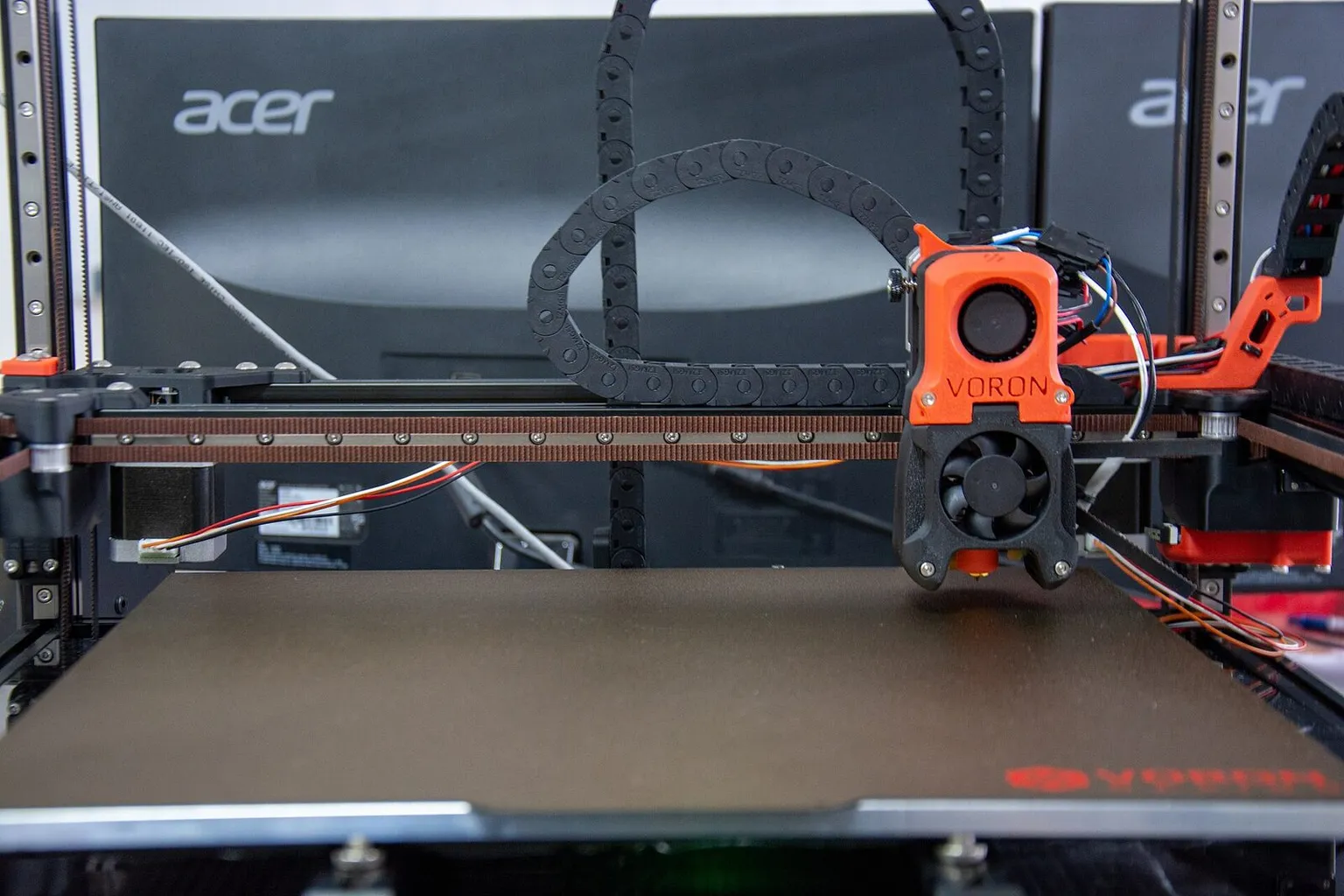

Klipper macros can automate anything you could type into the console. They heat, home, mesh and purge before a print, then park and shut down after it. They also pause for a filament change, wipe the nozzle, skip a failed part and ask you a question on screen. Each macro is a named command in your config that the slicer, the console or another macro calls.
What are Klipper macros?
A Klipper macro is a named G-code command you define yourself in a [gcode_macro] section of printer.cfg. Calling its name runs the commands listed under gcode:. Those commands are a Jinja2 template, so a macro can take parameters, read the printer’s live state, branch with if and loop with for.
[gcode_macro PARK]
description: Lift the nozzle and move to the back corner
gcode:
    {% set z = params.Z|default(10)|float %}
    SAVE_GCODE_STATE NAME=park_state
    G91
    G1 Z{z} F600
    G90
    G1 X200 Y200 F6000          ; placeholder: a safe spot inside your bed
    RESTORE_GCODE_STATE NAME=park_state
Type PARK or PARK Z=30 in the console and it runs. A [gcode_macro] section takes four options, per Klipper’s configuration reference:
gcode:holds the commands. It is the only required option.description:is the text shown byHELPand autocomplete. It defaults to “G-Code macro”.variable_<name>:stores a value the macro can read and change at run time. See macro variables.rename_existing:lets a macro replace a built-in command and keep the original under a new name. See rename_existing.
Names are case-insensitive, and any digits must come at the end of the name: Klipper accepts TEST_MACRO25 but rejects MACRO25_TEST3. To add the section to your config and reload it, follow adding macros to Klipper.
How Klipper runs a macro
Klipper’s command templates page states that “macros are first evaluated in entirety and only then are the resulting commands executed.” A value the macro reads from printer is the value from before any of its own commands ran. A macro that heats the bed and then checks printer.heater_bed.temperature sees the old temperature. To act after something finishes, use a wait command or a second macro. Making a macro wait covers both.
What a Klipper macro can use
Klipper’s command templates page lists what a macro template can work with:
- Parameters.
params.NAMEreads values passed on the call line. Klipper passes them “always in upper-case” and “always passed as strings”, so convert with|intor|float. See macro parameters. - Printer state.
printer.<section>reads live status, such asprinter.extruder.temperatureorprinter.toolhead.homed_axes. - Logic. Jinja2
{% if %}and{% for %}blocks choose and repeat commands. See if, else and loops. - Actions.
action_respond_info()prints a message to the console.action_raise_error()stops the macro and any macro that called it. - Saved values. With
[save_variables]enabled,SAVE_VARIABLEwrites a value to disk that survives a restart. - Timers. A
[delayed_gcode]section runs G-code after a delay or at startup. See running a macro on startup.
Which macros does Klipper include by default?
None. Klipper loads no macros of its own, so there is no default PRINT_START, END_PRINT or M600. Enabling [pause_resume] adds built-in PAUSE, RESUME, CLEAR_PAUSE and CANCEL_PRINT commands, but they do not park, retract or turn off heaters. The macros in Mainsail’s or Fluidd’s config file add that.
What Klipper’s own commands do
Klipper’s G-Codes reference lists the four [pause_resume] commands, and its source (pause_resume.py) shows what each does. PAUSE stops the print and saves the G-code state. RESUME moves back to the saved position at recover_velocity (default 50 mm/s) and continues. CANCEL_PRINT closes the file and clears the pause.
The rest of Klipper’s built-in commands, such as TURN_OFF_HEATERS, SAVE_GCODE_STATE and TEMPERATURE_WAIT, are the building blocks for macros.
Klipper does ship example macros in config/sample-macros.cfg: START_PRINT, END_PRINT, M600, M300 (beeper), M486 (cancel object) and M117, plus sensor queries and a few others. Nothing in that file loads by itself. You copy what you want into printer.cfg.
What Mainsail and Fluidd add
Both interfaces publish a read-only config file, mainsail.cfg or fluidd.cfg, that you load with one line such as [include mainsail.cfg]. Their READMEs give the install steps for mainsail-config and fluidd-config. The two files carry the same macros:
| Macro | What it does |
|---|---|
PAUSE |
Runs Klipper’s PAUSE, then retracts 1 mm, lifts 2 mm and parks 5 mm inside the X and Y maximums |
RESUME |
Reheats the nozzle if the printer went idle, refuses to start on a cold nozzle or an empty runout sensor, then returns and continues |
CANCEL_PRINT |
Retracts 5 mm, turns off heaters and the part fan, then cancels |
SET_PAUSE_NEXT_LAYER, SET_PAUSE_AT_LAYER |
Pause automatically at the next layer or a chosen layer |
The file also enables [virtual_sdcard], [pause_resume], [display_status] and [respond]. To change park positions or retract lengths, copy its _CLIENT_VARIABLE macro into printer.cfg below the include and edit the values there. PAUSE, RESUME and CANCEL_PRINT covers that setup.
Useful Klipper macros list
Most Klipper printers end up with some version of these. The command names are conventions, not requirements. A macro can have any name, as long as your slicer and other macros call that exact name.
| Macro | What it automates | Common command |
|---|---|---|
| Start print | Heats, homes, meshes and purges, so the slicer’s start G-code is one line (PRINT_START macro) | PRINT_START or START_PRINT |
| End print | Retracts, lifts and parks the head, then turns off heaters, fan and motors (END_PRINT macro) | PRINT_END or END_PRINT |
| Pause, resume, cancel | Parks safely on pause, reheats on resume, shuts down on cancel (setup) | PAUSE, RESUME, CANCEL_PRINT |
| Filament change | Pauses, parks and unloads when the slicer inserts M600 at a layer (M600 macro) | M600 |
| Runout response | Pauses when a filament sensor reports empty and runs your G-code (runout sensor) | runout_gcode in [filament_switch_sensor] |
| Purge line | Primes the nozzle with a line beside the print before the first layer (purge line) | your own, or LINE_PURGE from KAMP (Klipper Adaptive Meshing and Purging) |
| Nozzle wipe | Drags the nozzle across a brush to clear ooze before probing or printing (nozzle wipe) | CLEAN_NOZZLE |
| Adaptive mesh | Probes only the area this file’s objects cover (adaptive meshing) | BED_MESH_CALIBRATE ADAPTIVE=1 |
| Z offset per plate | Applies the saved Z offset for the build plate in use (per-plate offset) | SET_GCODE_OFFSET with [save_variables] |
| Chamber heat soak | Heats the chamber and waits before homing, and adds M141 and M191 (chamber heater control) | M141, M191 |
| Cancel one object | Skips a failed part and keeps printing the rest (exclude object) | EXCLUDE_OBJECT, M486 |
| Startup tasks | Runs G-code once Klipper is ready, after a delay, or on repeat (startup macros) | [delayed_gcode] |
| On-screen prompts | Shows a dialog with buttons in Mainsail or Fluidd and runs G-code from the choice (user input) | RESPOND TYPE=command MSG="action:prompt_begin ..." |
Two rows depend on other config. Adaptive meshing reads the object outlines a sliced file defines, so it needs [exclude_object] and a file with object labels, which the slicer or an upload preprocessor adds. Prompts need the [respond] module and a current Mainsail or Fluidd (version details).
Klipper macro examples
Three short macros show the patterns most others are built from.
An alias that hands a slicer’s M600 to Mainsail’s PAUSE, as the comments in mainsail.cfg suggest, with a park position and a minimum height:
[gcode_macro M600]
description: Filament change
gcode:
    PAUSE X=10 Y=10 Z_MIN=50    ; park front left, at least 50 mm above the bed
A start macro that takes temperatures from the slicer and falls back to defaults, trimmed from Klipper’s sample:
[gcode_macro START_PRINT]
gcode:
    {% set BED_TEMP = params.BED_TEMP|default(60)|float %}
    {% set EXTRUDER_TEMP = params.EXTRUDER_TEMP|default(190)|float %}
    M140 S{BED_TEMP}            ; start heating the bed
    G90
    G28                         ; home while the bed heats
    M190 S{BED_TEMP}            ; wait for the bed
    M109 S{EXTRUDER_TEMP}       ; heat the nozzle and wait
The slicer then calls it with one line, for example START_PRINT BED_TEMP=60 EXTRUDER_TEMP=210. Klipper’s Slicers page notes the benefit: start and end changes “do not require re-slicing.”
A guard that refuses to run unless the printer is homed:
[gcode_macro CHECK_HOMED]
gcode:
    {% if "xyz" not in printer.toolhead.homed_axes %}
      { action_raise_error("Home the printer first (G28)") }
    {% endif %}
Call CHECK_HOMED at the top of any macro that moves the head. Klipper evaluates a called macro only when it is invoked, so the check sees the homed state at that moment. If it fails, action_raise_error stops the calling macro too.
Sources
- Klipper documentation, Command templates (accessed October 10, 2026)
- Klipper documentation, Configuration reference (accessed October 10, 2026)
- Klipper documentation, G-Codes (accessed October 10, 2026)
- Klipper documentation, Slicers (accessed October 10, 2026)
- Klipper documentation, Bed mesh (accessed October 10, 2026)
- Klipper documentation, Exclude objects (accessed October 10, 2026)
- Klipper on GitHub, config/sample-macros.cfg (accessed October 10, 2026)
- Klipper on GitHub, klippy/extras/pause_resume.py (accessed October 10, 2026)
- Mainsail Crew on GitHub, mainsail-config (README and mainsail.cfg) (accessed October 10, 2026)
- Fluidd on GitHub, fluidd-config (README and fluidd.cfg) (accessed October 10, 2026)
- Mainsail documentation, Macro prompts (accessed October 10, 2026)
- Voron Design on GitHub, Voron 2.4 Octopus sample config (accessed October 10, 2026)
- Klipper Adaptive Meshing and Purging (KAMP) on GitHub (accessed October 10, 2026)