Guide
Orbiter extruder v2.0 vs v2.5: weight, gearing, sensor
The Orbiter v2 is a 135 g direct drive extruder with a 7.5:1 planetary gearbox, 12 mm dual drive gears and LDO's LDO-36STH20-1004AHG pancake stepper, made under license by LDO Motors. The v2.5 keeps the v2.0 body, motor and 690 steps/mm, and swaps in a knurled main shaft and flat-bottom, RNC-coated drive gears.
Edited by 3D Printeray EditorsPublished Last verified 11 min read
In this section: Extruders(14)
On this page (10)
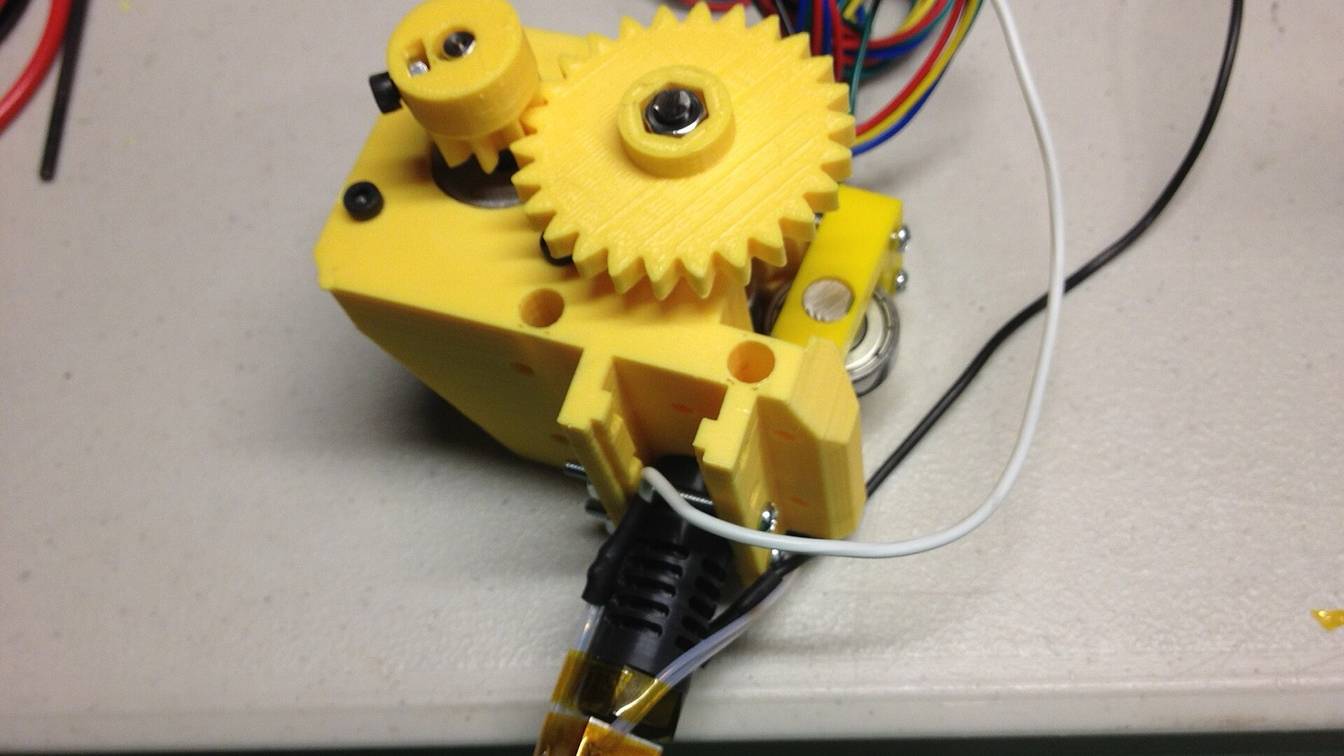

The Orbiter v2 is a direct drive extruder that weighs about 135 g, reduces its motor 7.5:1 through a planetary gearbox and grips the filament between two 12 mm drive gears. Róbert Lőrincz (Orbiter Projects) designed it, and LDO Motors builds it under license around its own LDO-36STH20-1004AHG pancake stepper, set to 690 steps/mm. The current v2.5 keeps the v2.0 body, motor and settings and changes only the drive gears and their shaft.
What is the difference between Orbiter v2.0 and v2.5?
The Orbiter v2.5 uses the v2.0 body, motor and firmware settings (690 steps/mm), so mounts and configs carry over. Only the drive train changes. A knurled main shaft cuts measured gear eccentricity (wobble) from 50 to 140 µm down to 20 to 30 µm, and flat-bottom, RNC nano-coated gears keep the same grip diameter when the filament shifts sideways.
Both changes aim at a steadier extrusion speed, which the designer links to smoother walls without diagonal artifacts. The v2.5 gears are hardened to HRC60+ (Rockwell C scale); the v2.0 used hardened gears made by Bondtech. The internal bearing also changed from an MF148ZZ to an MF679ZZ, whose 9 mm bore makes assembly easier.
A v2.0 owner can convert with LDO’s upgrade kit, $22.99 at West3D on November 4, 2026. The designer says it fits only genuine LDO Orbiter v2.0 extruders.
Only two parts are required: the shaft with its pressed-on drive gear, and the new idler gear. The rest of the kit (bearings, latch, planetary gears and their housing) is spares, which the designer recommends fitting too. Three 0.1 mm shims line the drive gear up with the filament guide, and the step-by-step swap is on the designer’s Orbiter v2.5 page. Recalibrate the extrusion afterwards: the new gear cut can shift steps/mm slightly.
Orbiter versions compared
In release order:
| Version | Weight | Gear ratio | Motor | Drive gears | Filament sensor | Mounting |
|---|---|---|---|---|---|---|
| Orbiter v1.5 (discontinued) | About 150 g | 7.5:1 | LDO-36STH20-1004AHG | 12 mm diameter, 15 mm long; plastic filament exit guide | Orbiter filament sensor add-on, printable housing | Molded v1.5 housing |
| Orbiter v2.0 | About 135 g | 7.5:1 | LDO-36STH20-1004AHG | 11 mm long, hardened, made by Bondtech; stainless steel exit guide | Orbiter filament sensor or the smart filament sensor (add-ons) | Mounting screws in line with the filament path |
| Orbiter v2.5 | 135 g | 7.5:1 | LDO-36STH20-1004AHG | Flat-bottom wide-cut, RNC-coated, HRC60+, on a knurled shaft | Same add-ons as v2.0 | Same body as v2.0; standard and mirrored housings |
| Smart Orbiter v3.0 | 175 g with hotend | 7.5:1 | LDO-36STH20-1004AHG | 12 mm, RNC-coated, on an octagonal shaft | Built in, with auto-load and auto-unload | Extruder and hotend in one; the designer keeps a separate v3.0 mount list |
| Orbiter v3.5 | 175 g with standard hotend | Same as v3.0 (690 steps/mm) | Not listed | Knurled shaft | Built in, using the v2 smart sensor’s switch | 0.5 mm wider than v3.0; takes the LDO hotend or an E3D Revo |
The v1.5 row’s weight comes from MatterHackers’ clearance listing for that model, which also gives 650 to 700 steps/mm and says the item “is being discontinued”. That listing heads its spec block “V2.0”, but its figures (about 150 g, 15 mm gears) do not match the designer’s v2.0 specs (135 g, 11 mm gears), so this page treats them as v1.5 values. The v2.5’s 135 g and motor come from Filastruder’s and Fabreeko’s listings. All other figures are from the designer’s pages.
What changed from Orbiter v1.5 to v2.0?
The v2.0 is a ground-up redesign with custom parts, where the v1.5 used a housing molded by Vivedino/FormBot. The changes, per the designer (the v1.5’s weight and settings are from MatterHackers’ listing):
- Gears: 11 mm long instead of 15 mm, made and hardened by Bondtech.
- Size and weight: 11.6% shorter and about 135 g, against about 150 g for the v1.5.
- Force: about 40% more extrusion force in real printing conditions, from a redesigned motor.
- TPU: a stainless steel exit guide sits 0.2 to 0.3 mm from the gears, so flexible filament can only go into the hotend. The designer calls the v1.5’s plastic guide, set farther from the gears, one of its weaknesses for TPU.
- Details: flipped gears move the filament path toward the center, and a machined PEEK (polyether ether ketone) sleeve replaces the idler’s metal pin bearing. The tension screw now keeps its spring and washer captive. The housing is molded from 30% glass-filled PA12 (nylon 12) rated to 180 °C.
- Settings: 690 steps/mm and 0.85 A RMS, against 650 to 700 steps/mm and 0.7 A RMS for the v1.5.
The v2.0 housing is shorter and its motor sits rotated an extra 10 degrees, so use a mount made for the v2.0 or v2.5.
How much does the Orbiter extruder weigh?
The Orbiter v2.0 weighs about 135 g as a complete extruder, and the v2.5, built on the same body, is listed at 135 g. MatterHackers lists the older v1.5 at about 150 g. The Smart Orbiter v3.0 and v3.5 weigh 175 g including the hotend, which the v2 weights exclude.
To compare a v2 with a v3, add your hotend’s weight to the 135 g. For a whole toolhead, also add the mount, fans and any filament sensor. The Sherpa Mini and other light extruders are weighed side by side in Sherpa Mini vs Orbiter.
What is the Orbiter extruder gear ratio?
The Orbiter’s gear ratio is 7.5:1, from a single-stage planetary gearbox: a 10-tooth pinion on the motor drives three 27-tooth Delrin (acetal) planet gears. With 12 mm drive gears that gives 690 steps/mm at 16 microsteps. Every version from v1.5 to the Smart Orbiter v3.0 uses the same 7.5:1 reduction.
The designer argues that the resulting steps/mm matters more than the ratio. More steps per millimeter means more pushing force but less acceleration. His sweet spot is about 400 steps/mm for the NEMA 17 pancake motors on most extruders and about 700 steps/mm for the smaller 36 mm round NEMA 14, which has about half the torque.
Reaching about 700 steps/mm with 12 mm drive gears takes 7.5:1, where a BMG-style extruder uses 3:1 and the Sherpa Mini 5:1 or 6.25:1, depending on its motor pinion. The three planet gears share the load, and the designer says no ground-down planetary gears have been reported.
The designer’s published settings for the v2.0 and v2.5:
- Acceleration: up to 8000 mm/s² with filament loaded; limit it to 3000 mm/s² to cut the clicking on fast direction changes.
- Retraction: 1 to 1.5 mm at up to 120 mm/s, 30 mm/s for TPU.
- Firmware:
M92 E690in Marlin. For Klipper, start atrotation_distance: 4.69, the designer’s value; LDO’s configuration sheet gives 4.637. Driver blocks, pressure advance and the calibration test are in Orbiter extruder Klipper config.
Other extruders, with their weights and steps/mm, are compared in extruder upgrades.
Which motor does the Orbiter extruder use?
The Orbiter v2.0 and v2.5 use LDO’s LDO-36STH20-1004AHG, a 36 mm round NEMA 14 pancake stepper rated to 180 °C. The designer specifies 0.85 A RMS (1.2 A peak) with stealthChop, the TMC drivers’ quiet mode, turned off. At that current the motor runs at 65 to 75 °C.
Keep it under 75 °C at room temperature, or 80 to 85 °C in an enclosed chamber. The limits are the Delrin gears (120 °C) and filament softening on hot drive gears, worst with TPU and PLA.
The failure the designer warns about is a wrong sense resistor value in the firmware. Entering 0.11 Ω for a driver that has 0.051 Ω more than doubles the current. The motor’s heat then rises from about 3.5 W to over 14 W, enough to melt the plastic gears. Read the value off the two large resistors beside the driver (R110 is 0.11 Ω, R051 is 0.051 Ω). To check that your setting takes effect, set 0.2 to 0.3 A first: the motor should turn but skip easily.
What does the Orbiter v2 smart filament sensor do?
The Orbiter v2 smart filament sensor detects runout, loads filament when you insert it, has a button to unload it, and pauses the print when the filament tangles. A spring-loaded ring trips when the filament pulls with more than 1.5 to 2 kg of force for over a second. It fits the v2.0 and v2.5 and is designed around Klipper.
How it works and what to set:
- Inside: two switches (filament present, tangle), an unload button and an ATtiny412 microcontroller that debounces and filters the signals.
- Status light: red, no filament; green, filament present; blue blinking, unloading; yellow blinking, tangle.
- Wiring: four wires: GND, 3.3 V (5 V optional), filament sense and a shared tangle/unload line. Connect the two signal wires to spare digital inputs. The Klipper macro reads the shared line as a tangle while printing and as the unload button otherwise.
- Klipper: add
Orbiter2_smartSensor.cfgfrom the designer’s Orbiter 2 Smart Sensor repository and enter your pins under[filament_switch_sensor O2_sensor]and[gcode_button filament_unload]. Setmin_extrude_tempin[extruder](he uses 180 °C), because the macros fail with cold extrusion allowed. The file brings its ownPAUSEandRESUMEmacros, so keep only one set. - False tangle alarms: friction in a long or worn PTFE tube, a hard-turning large spool, or fast moves with a loose PTFE tube. Secure the tube at its entry end. The designer does not recommend this sensor version with an MMU (multi-material unit).
Filastruder listed LDO’s smart sensor at $19.99, in stock, on November 4, 2026. The older Orbiter filament sensor handles runout, auto-load and the unload button but not tangles. It works with Klipper, RepRapFirmware and Marlin, and with a printed housing it also fits the v1.0 and v1.5. General Klipper runout-switch wiring is in Klipper filament runout sensor.
Is there an Orbiter v3?
Yes, two: the Smart Orbiter v3.0 (SO3), made with LDO, and the Orbiter v3.5 that followed it. Each is an extruder and hotend in one unit, weighing 175 g with the hotend and running at 690 steps/mm. A v3 replaces your hotend too, so it needs a mount made for the v3.
The v3.0 has built-in electronics: filament sensing, automatic unload, an RGB-lit filament inlet, a hotend light and a temperature sensor. Its hotend is a plated copper block with a 72 W ceramic heater and a Bondtech CHT nozzle (30 to 40 mm³/s), and a version takes E3D Revo nozzles instead. A tension lever with three set positions replaces the v2’s thumb screw.
The v3.5 combines the front heatsink and filament guide in one part, with fins that cut fan noise by about 10 dB. It also gets a knurled shaft like the v2.5’s and a filament sensor built on the v2 smart sensor’s switch. Its two RGB LEDs need chain_count: 2 in Klipper. It is 0.5 mm wider than the v3.0 and takes the LDO hotend or an E3D Revo, which is 4 mm longer.
The designer also lists an Orbiter Quatro as under development: a 101 g four-point drive extruder with built-in filament movement sensing.
Where can you buy a genuine LDO Orbiter v2.5?
From a seller on the designer’s official reseller list. In the US it names Fabreeko, Filastruder, KB-3D, Mandala Rose Works, PartsBuilt, Tiny Machines 3D and West3D, plus LDO’s own store and the online sellers BIQU, Blurolls, Mellow and Trianglelab. LDO Motors is the only maker the designer licenses, and it pays him a royalty on each Orbiter it sells.
US prices for a complete v2.5 on November 4, 2026, lowest first:
| Seller | Listing | Price | Stock |
|---|---|---|---|
| Filastruder | LDO Orbiter v2.5, standard | $59.99 | In stock |
| Trianglelab | Orbiter Extruder V2.5 “with LDO Motor” | $62.82 (sale; listed at $73.90) | In stock |
| West3D | LDO Orbiter V2.5, complete with motor | $64.99 | In stock |
| Fabreeko | LDO Orbiter 2.5 Extruder 1.75mm | $65.99 | Out of stock |
Trianglelab is on the designer’s reseller list, but its listing names an LDO motor without saying who makes the housing and gears. Two facts matter when a listing is not LDO’s. The v2.5 upgrade kit fits only genuine LDO v2.0 extruders. And the designer has written that he had no part in the RNC-coated gears on AliExpress that some sellers called an authorized v1.5 version.
Filastruder’s listing notes that the mirrored version has a housing and latch printed by Multi Jet Fusion (MJF) instead of injection-molded ones. On November 4, 2026 it offered only the standard version.
Can you fit an Orbiter extruder on an Ender 3?
Yes, with a printed mount. The Ender 3, Ender 3 Pro and Ender 3 V2 ship with a Bowden extruder, so fitting an Orbiter is a direct drive conversion. Print a carriage mount, run a short PTFE tube to the hotend, extend the motor cable and change E-steps from the stock 93 to 690 steps/mm.
Mounts that name the Ender 3:
- Orbiter v2.0 ender 3 on Printables (oldcrazyeye): bolts on behind the stock hotend mounting bracket, between the bracket and the wheels. It needs two M3 heat-set inserts and the stock steel spacers pressed in, plus a short PTFE tube to the hotend. Print it in PETG or stronger; the designer of the mount says PLA will likely crack. It should take any fan duct that is no taller than the Ender 3 bracket.
- The Orbiter designer’s own Ender 3 V2 adapter keeps the stock hotend assembly, with and without a BLTouch. It is linked from the Orbiter v2.0 page under “Adapters & mounts”, along with Mars Orbiter (Ender 3, Ender 3 Pro, Ender 3 V2, CR-10) and Hero Me Gen6 for Creality printers.
Then set the firmware:
- E-steps. Send
M92 E690and save withM500. Then calibrate with a 300 to 400 mm extrusion, which the designer says is more accurate than 100 mm. On Klipper, set the rotation distance instead, as shown in Orbiter extruder Klipper config. - Motor current. 0.85 A RMS (
M906 E850) where the drivers take current from firmware. On a board that sets current with a trimmer, the designer’s Vref (the reference voltage you measure on the trimmer) is 1.2 V for TMC2208, TMC2209 and TMC2225 drivers with 0.11 Ω sense resistors. Check the resistor on your board first. - Retraction. 1 to 1.5 mm, down from the Bowden profile’s several millimeters.
The rest of the conversion (cable routing, reversing the motor direction, probe offsets and pressure advance) is in how to add direct drive to an Ender 3. Ready-made kits for the same printer are compared in Ender 3 extruder upgrade. The Ender 3 S1 and V3 models already ship with direct drive; the S1 series uses Creality’s Sprite extruder.
Sources
- Orbiter Projects, Orbiter v2.0 (accessed November 4, 2026)
- Orbiter Projects, Orbiter v2.5 (accessed November 4, 2026)
- Orbiter Projects, Orbiter v1.5 (accessed November 4, 2026)
- Orbiter Projects, The true story of Orbiter v2.0 (accessed November 4, 2026)
- Orbiter Projects, The true story of the Orbiter extruder (accessed November 4, 2026)
- Orbiter Projects, Smart filament sensor for Orbiter v2 (accessed November 4, 2026)
- LorinczElectronics on GitHub, Orbiter-2-Smart-Sensor (accessed November 4, 2026)
- Orbiter Projects, Orbiter filament sensor (accessed November 4, 2026)
- Orbiter Projects, Smart Orbiter v3.0 (accessed November 4, 2026)
- Orbiter Projects, Orbiter v3.5 (accessed November 4, 2026)
- Orbiter Projects, home page (Orbiter Quatro under development) (accessed November 4, 2026)
- Orbiter Projects, Find an official Orbiter reseller (accessed November 4, 2026)
- MatterHackers, LDO Motors Orbiter Dual Drive Direct Extruder V1.5 (clearance listing) (accessed November 4, 2026)
- Fabreeko, LDO Orbiter 2.5 Extruder 1.75mm (accessed November 4, 2026)
- Filastruder, LDO Orbiter v2.5 (standard/mirrored) (accessed November 4, 2026)
- West3D, LDO Orbiter Extruder V2.5 (Orbiter V2.5 and V2.0 to V2.5 Upgrade Kit) (accessed November 4, 2026)
- Trianglelab, Orbiter Extruder V2.5 (accessed November 4, 2026)
- Filastruder, LDO Orbiter Extruder v2.0 Smart Filament Sensor (accessed November 4, 2026)
- Printables, Orbiter v2.0 ender 3 (oldcrazyeye) (accessed November 4, 2026)