The XL's carriage has no extruder of its own. It picks a complete Nextruder toolhead out of a dock, prints with it, parks it and picks the next one. Here is how the lock, the docks and a tool change work, and how far you can expand a single-tool machine.
The Prusa XL tool changer is a purely mechanical lock on the print-head carriage. It picks up a complete Nextruder toolhead from a dock at the back of the frame, prints with it, puts it back and picks up the next one. The XL takes 1 to 5 toolheads, and a single-tool XL can be upgraded later.
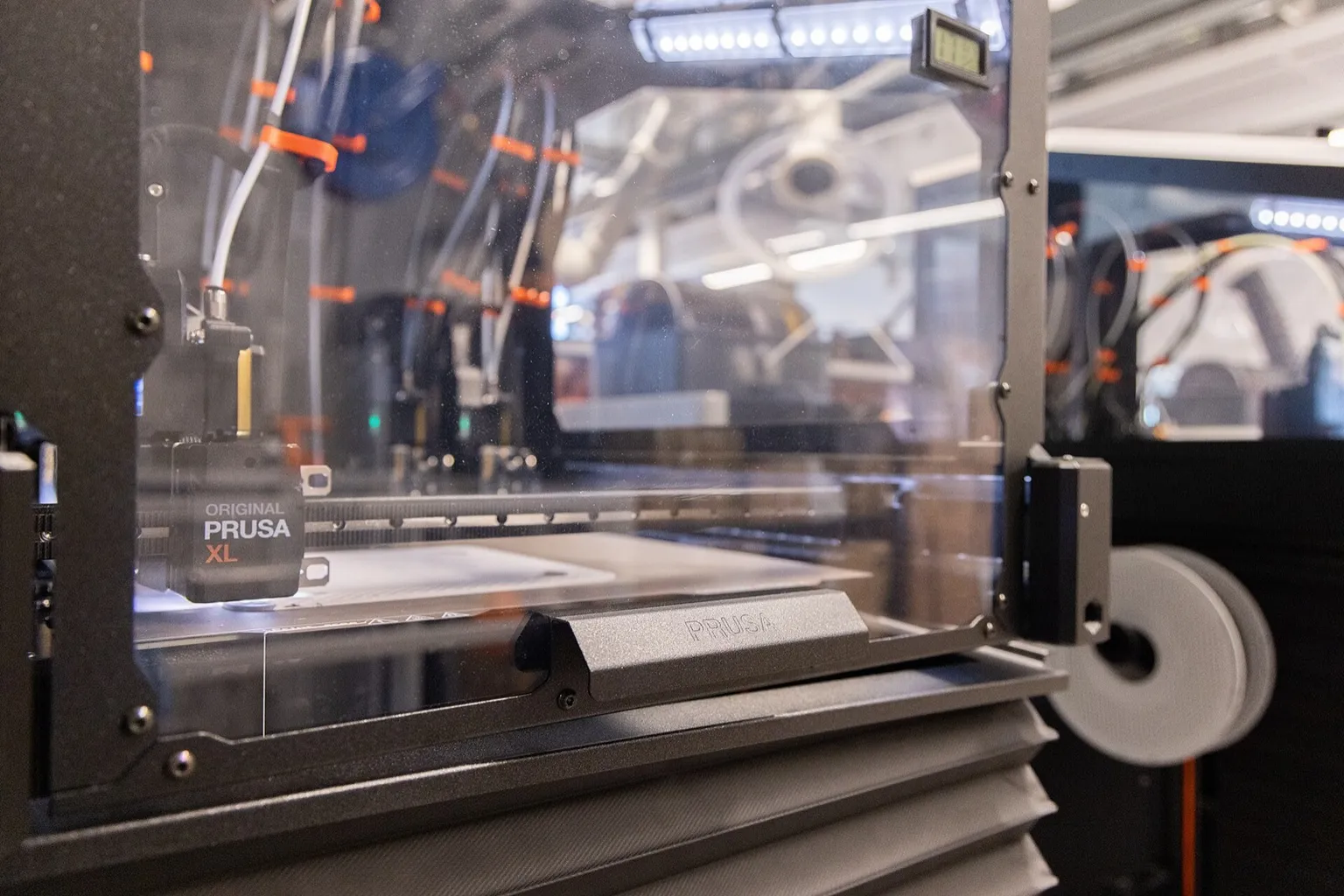
The Prusa XL’s toolchanger carriage carries no extruder. It drives to a dock at the back of the frame, couples onto a parked toolhead and locks it with two metal brackets, with no motor or electromagnet. To swap, it parks the toolhead in its dock and slides sideways to release the brackets. Then it picks up the next one.
Prusa’s handbook says “the toolchanger is purely mechanical and does not feature an electronic lock”. At launch, Prusa described it as “a kinematic coupler mechanism that doesn’t need electromagnets or other active elements to work.”
The parts
- Toolchanger carriage. It rides the CoreXY gantry (the belt-driven X/Y motion system) and carries whichever toolhead is active. The lock is two metal brackets. To free a tool by hand, you slide both brackets to the side.
- Cheese board. Each multi-tool toolhead has one at the front. It is the part the lock grabs: a circuit board, 3 hexagonal positioning pins, 2 carrying pins and 2 nozzle LEDs. It connects to the toolhead’s own Dwarf control board, so an XL has as many Dwarf boards as toolheads. Prusa’s troubleshooting article also lists three coupler pins per tool, which need lubrication.
- Docks. There is one dock per toolhead, bolted along the rear of the frame. While a toolhead is parked, its nozzle rests on a metal lip with a silicone surface, which stops it oozing.
- Toolheads. Every toolhead is a complete Nextruder with its own hotend, heater, extruder motor and fans. The multi-tool Nextruder has a different front, with the toolchanger connector. Prusa says single-tool and multi-tool Nextruders cannot be swapped freely.
- Sensors. Prusa says sensors confirm that each swap succeeded. If a pick or park fails, the printer pauses with the “Toolchanger problem” error, covered in fixing the Prusa XL tool changer problem error.
- Park. The carriage brings the active toolhead to its own dock and slides to the right. That releases the lock and leaves the tool in the dock. Prusa’s manual recovery steps describe the same move.
- Seal. The parked nozzle sits on the silicone-faced lip, so it does not drip while it waits.
- Pick. The carriage moves to the next dock. The hexagonal pins locate the toolhead and the brackets lock it.
- Heat. Parked toolheads can stay heated. Prusa says each toolhead’s own heater keeps the nozzle “very close to the target temperature” and usually reaches full temperature during the change. Toolheads that won’t be needed for a while switch off.
- Offset and prime. The firmware applies that toolhead’s calibrated offset. PrusaSlicer’s small wipe tower stabilizes nozzle pressure after the tool leaves its dock. It is not a purge block, so waste stays low.
Prusa does not publish an official tool change time. Its February 2026 blog post says: “We’ve intentionally avoided publishing a single headline number, because toolchanges are tricky to measure fairly.” The heater in every toolhead is why Prusa expects the XL to stay ahead of its own nozzle-swapping INDX system on swap speed. INDX heats each picked-up nozzle from cold.
The Prusa XL takes up to five toolheads, each parked in its own dock. Prusa sells the XL with 1, 2 or 5 toolheads. The Original Prusa XL handbook covers machines with “2-5 toolheads”, so 3 or 4 also work. Going past two toolheads needs an electronics expansion kit, and a single-tool XL can be upgraded later.
| Toolheads |
Toolchanger |
Filament inputs |
Added calibrations |
| 1 |
None (single-tool Nextruder) |
1, on the side |
None |
| 2 |
Yes, 2 docks |
Left side (1-2) |
Dock Position, Tool Offset |
| 3 to 5 |
Yes, one dock per toolhead, plus the electronics expansion kit |
1-3 left, 4-5 right |
Dock Position, Tool Offset |
Yes. Prusa’s XL+ product page says to “start with a single-tool XL+ and expand it later”. Prusa sells three upgrade kits, each with an assembly manual in its Knowledge Base. Prices are from US reseller Printed Solid, listed on October 14, 2026.
| Kit |
What it adds |
US price |
| Single-Tool to Dual-Head |
Toolchanger, 1 multi-tool Nextruder, parts to convert your existing Nextruder to the multi-tool front |
$659 |
| Dual-Head to Five-Head |
3 multi-tool Nextruders, electronics expansion kit (XLSplitter board and an extra power supply) |
$1,519 |
| Single-Tool to Five-Head |
Toolchanger, 4 multi-tool Nextruders, parts to convert your existing Nextruder, electronics expansion kit |
$2,099 |
Only the five-head kits include the electronics expansion. Prusa’s 2022 FAQ says “if you want more than two tool heads, you will need to install an expansion card”.
After the upgrade, the printer detects the new toolheads and adds two calibrations to its Selftest (the guided setup check):
- Dock Position Calibration. You remove the dock pins and loosen each dock. The printer aligns the tool, then you tighten the dock again. It takes about 3 minutes per toolhead.
- Tool Offset Calibration. This measures where each nozzle sits relative to the first. Printing stays disabled until it passes for every tool.
Prusa says the whole Selftest takes 15 to 60 minutes, depending on configuration. For why the offset step matters and how other toolchangers handle it, see toolchanger tool offsets.
No. Prusa lists the same 360 × 360 × 360 mm (46.7 l) build volume for every configuration, five-head included. The docks sit at the back of the frame. More toolheads add docks, spool holders, side filament sensors and Dwarf boards. A multi-tool XL+ also adds the offset sensor. None of that changes the published volume.
Prusa announced the XL+ on August 13, 2026, and now sells it in place of the XL. The XL+ handbook describes the same two-bracket lock, and Prusa says existing XL toolheads fit.
Calibration changed. The original XL measured tool offsets by touching a calibration pin screwed into the middle of the bed. The XL+ has a permanently mounted Tool Offset Sensor, which Prusa says is “about 20 times faster”. Each tool cleans its nozzle on the built-in wiper, measures its Z height on the sheet and finds its nozzle center over the sensor.
XL-to-XL+ upgrade kits come in 1, 2 and 5 toolhead versions. US reseller Printed Solid listed them at $289, $389 and $619 on October 14, 2026.
Only the XL swaps complete toolheads. Prusa’s INDX system for the CORE One swaps passive nozzles instead of whole print heads. It handles up to eight materials and heats each picked-up nozzle by induction.
.jpg)