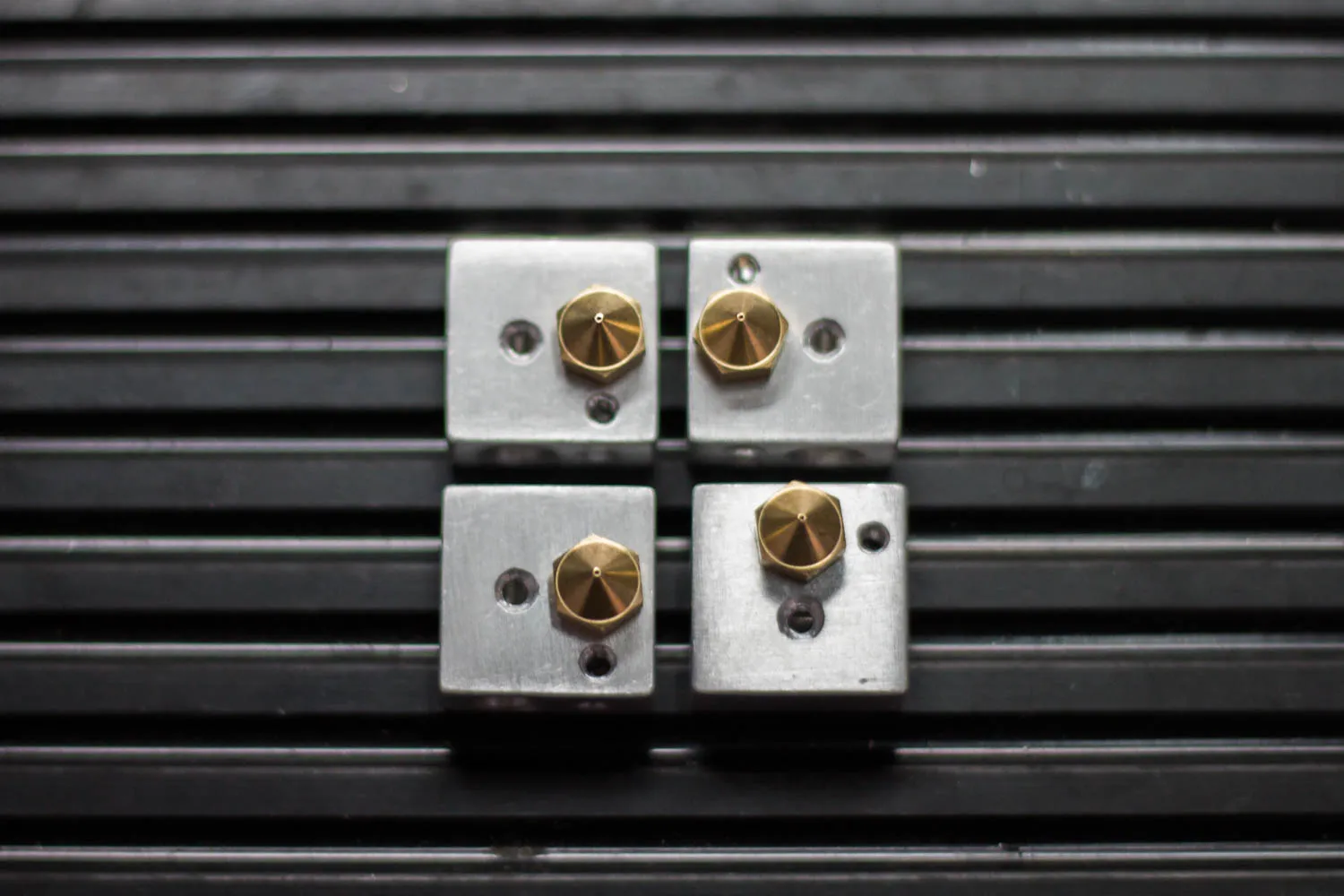
Hardened steel nozzles are for abrasive filaments such as carbon fiber, glass fiber and glow PLA. Stainless steel nozzles resist corrosion and print unfilled filaments, but wear quickly on abrasives. The Bambu Lab A1 ships with stainless, and its hardened steel hotend costs $2 more.
Use hardened steel if your filament contains carbon fiber, glass fiber or glow pigment. Stainless steel resists corrosion and handles unfilled PLA, PETG, ABS, ASA and TPU, but wears quickly on abrasives. The two steels conduct heat about equally (roughly an eighth to a seventh as well as brass), and at the Bambu Lab US store on October 22, 2026, a hardened steel hotend cost the same as stainless or $2 more.
What is the difference between hardened steel and stainless steel nozzles?
Hardened steel nozzles are heat-treated tool steel at about 55 to 62 HRC (Rockwell C hardness), made to resist carbon fiber, glass fiber and glow filament. Stainless steel nozzles, about 20 HRC, resist corrosion and suit unfilled filaments such as PLA, PETG and ABS but wear quickly on abrasives. Both steels conduct heat about equally, far less than brass.
| Property |
Stainless steel |
Hardened steel |
Brass (reference) |
| Material named by makers |
303 stainless (McMaster-Carr’s V6 nozzles); Bambu Lab and Phaetus name no grade |
A2 tool steel (Micro Swiss); “imported die steel” (Phaetus); Bambu Lab names no grade |
Brass; Bambu Lab sells no brass nozzles |
| Hardness |
20 HRC (Bambu Studio’s nozzle table); Rockwell C19 (McMaster-Carr, 303) |
55 HRC (Bambu Studio); 57 to 62 HRC (Micro Swiss A2); over 60 HRC (Phaetus) |
Rockwell B50 to B82 (McMaster-Carr) |
| Thermal conductivity, W/m·K |
14.4 (type 304, 20 °C); 16.2 (type 303, 100 °C) |
15.8 (A2 tool steel, 20 °C) |
111 to 120 (yellow and cartridge brass, 20 °C) |
| Strengths Bambu Lab lists |
“High temperature resistance”, “corrosion resistance”, “cost-effective” |
“Harder than stainless steel”, “superior wear resistance” |
Not applicable |
| What it is for, per its maker |
Bambu Lab: “most non-abrasive general-purpose filaments”, such as PLA, ABS, ASA, PETG, TPU and PVA |
Bambu Lab: “any abrasive filaments with hard particles”, such as PA-CF, PLA-CF, PETG-CF, glow and wood |
E3D: “standard non-abrasive applications” |
| Carbon fiber wear in 3D Verkstan’s test |
Worn after 1 kg |
Worn after 4 kg |
Worn after 0.3 kg |
| Food-contact claims |
Phaetus: “can be used for food grade applications”; McMaster-Carr: 303 tips “don’t contain lead” |
None in the listings checked |
Prusa Research: “not considered food-safe, as it wears out” |
| Temperature rating |
Same as hardened steel within each Bambu Lab hotend family |
Same as stainless on Bambu Lab hotends; 450 °C (Phaetus V6); 500 °C, but abrasives not above 350 °C (E3D V6) |
300 °C (E3D V6) |
3D Verkstan makes the ruby-tipped Olsson Ruby nozzle, so the wear row comes from a maker’s own test. The wear-resistant nozzle comparison covers harder materials, from tungsten carbide to ruby, and the temperature offset when moving from brass to steel.
The steel conductivity figures fall within 2 W/m·K of each other. Bambu Lab’s A1 and P1S hotend guides mention no temperature or flow change when a hardened hotend replaces a stainless one, only that the new nozzle type be set on the printer. Bambu Studio does use the hardness figures: it warns when a filament needs a harder nozzle than the one fitted (details in the A1 section).
Hardened steel nozzle or stainless steel: which should you use?
Choose by filament. Bambu Lab requires hardened steel for every carbon- or glass-fiber filament (the -CF and -GF grades) and for glow PLA. It marks hardened steel optional for unfilled PLA, PETG, TPU, ABS, ASA, PC and PA, and fits it as standard on the X1 Carbon, X1E, P2S, X2D, H2D, H2S and H2C.
- Unfilled filaments only. Stainless steel covers them, and it is the stock nozzle on the Bambu Lab A1, A1 mini, A2L and P1S.
- Carbon fiber, glass fiber or glow filament. Hardened steel. Bambu Lab’s filament guide says: “Do not use a stainless steel or brass nozzle. Their hardness is insufficient, so they wear out quickly.” In its P1S upgrade guide, a stainless nozzle used for 10 hours of PETG-CF came out with a visibly enlarged orifice, and Bambu Lab warns that “for the most abrasive filaments, the nozzle can be damaged after a single print.” Signs of nozzle wear shows what to check.
- Marble, sparkle, wood- or metal-filled PLA. Bambu Lab’s own pages disagree. Its A1/A2 hotend listing marks hardened steel “Optional” for PLA Sparkle, PLA Marble and wood-, rock- or metal-filled PLA. Its filament guide’s table says “Not Required” for PLA Marble and PLA Wood, but the text of the same guide lists PLA Marble and PLA Sparkle among the particle-filled filaments not to run through stainless steel. If you print them often, a hardened nozzle avoids the question; on the A series it costs $2 more.
- A 0.2 mm nozzle. Bambu Lab makes its 0.2 mm nozzles in stainless steel only. Its filament guide says not to run filled filaments through 0.2 mm at all, because “the clogging risk is extremely high.”
- Parts that touch food. In the listings checked, only stainless steel nozzles carry food-contact claims (Phaetus, McMaster-Carr), and Prusa Research says a stainless steel or titanium nozzle is needed “if you are even considering printing with food in mind.” Prusa adds that the grooves between layers “are a seedbed for bacteria,” so a stainless nozzle alone does not make a print food safe.
When to use a hardened steel nozzle goes through the filaments one by one.
How much more does a hardened steel nozzle cost?
On Bambu Lab printers, nothing to $2. Prices are from October 22, 2026, sorted by the stainless price, lowest first.
| Part |
Fits |
Stainless steel |
Hardened steel |
| Bambu Hotend - A1/A2 |
A1, A1 mini, A2L |
$9.99 (0.4 mm); $11.99 (0.2 mm) |
$11.99 (0.4, 0.6 or 0.8 mm) |
| Phaetus V6 nozzle, at Fabreeko |
Hotends that take V6 nozzles |
$12.50 |
$14.99 |
| Bambu Hotend - X1C or P1 Series, hotend only |
X1 Carbon, P1P, P1S |
$14.99 (0.2 mm only) |
$14.99 |
| Bambu Hotend - H2/P2S/X2D, standard flow |
H2D, H2S, H2C (left), P2S, X2D |
$17.99 (0.2 mm only) |
$17.99 |
| Bambu Hotend - X1C or P1 Series, complete hotend |
X1 Carbon, P1P, P1S |
$34.99 (0.2 mm only) |
$34.99 |
Bambu Lab prices are its US store’s. The A series is the only family for which Bambu Lab sells a 0.4 mm stainless hotend. For the others, stainless comes only in 0.2 mm at the hardened steel price, so a 0.4 mm replacement for a P1S is hardened steel. Phaetus prices are from Fabreeko, a US retailer, which listed the Phaetus brass V6 nozzle at $5.00 and showed the 0.4 mm stainless and 0.4 mm hardened sizes out of stock that day.
Does the Bambu Lab A1 have a hardened steel or stainless steel nozzle?
The Bambu Lab A1 ships with a 0.4 mm stainless steel nozzle and hardened steel extruder gears. For carbon fiber, glass fiber or glow filament, Bambu Lab says to swap in its hardened steel A1 hotend: $11.99 in 0.4, 0.6 or 0.8 mm at the Bambu Lab US store on October 22, 2026.
Bambu Lab’s A1 FAQ gives PLA-CF/GF, PLA Glow-in-the-dark, PETG-CF/GF and PAHT-CF/GF as examples of filaments that need the swap. The A1 mini and A2L ship with the same 0.4 mm stainless nozzle, and their versions of the hotend are also $11.99 in hardened steel. Hardened steel nozzles on Bambu Lab printers walks through the swap.
Bambu Lab A1 hardened steel nozzle vs stainless: what changes
- No print settings. Bambu Lab’s A1 hotend guide asks only that you set the new nozzle on the printer (Settings > Maintenance > Nozzle), then check that the hotend does not wobble and extrudes normally. Since Bambu Studio V02.01.01.52, the nozzle field under Printer Parts is display-only, so you change the nozzle type on the printer itself.
- The hardness check. Bambu Studio compares each filament with the nozzle type the printer reports. Its Bambu PLA-CF, PETG-CF and PLA Glow profiles require 40 HRC: above the 20 it assigns stainless steel, below the 55 it assigns hardened steel. With stainless set, the send dialog warns that the filament “may cause nozzle wear, leading to material leakage and unstable flow.”
- Temperature. The A1’s hotend tops out at 300 °C with either nozzle, per Bambu Lab’s specifications.
- Extruder gears. Already hardened steel on the A1, according to Bambu Lab’s A1 FAQ, so the hotend is the only part to change. Bambu Lab’s $9.99 A1 gear assembly is a replacement for worn gears.
- The open frame. It stays a limit with either nozzle. Bambu Lab’s A1 FAQ advises against PA-CF/GF, PET-CF/GF and PPA-CF/GF for large or dense parts that need interlayer strength. Small, low-infill parts can still be printed.
- AMS lite. Bambu Lab’s filament guide lists Bambu PLA-CF as compatible with the AMS lite, but PETG-CF as “Not Recommended” for it, and PLA Glow as “Not Recommended” for the AMS and AMS lite. AMS-compatible filaments covers the rest.