Guide
Hotend vs nozzle: what's the difference?
No, a hotend is not a nozzle. The nozzle is the tip the melted plastic leaves through; the hotend is the whole assembly that melts the filament: nozzle, heater block, heater, temperature sensor, heat break and heatsink with its fan. A worn nozzle needs a new nozzle, or on a Bambu Lab printer a new hotend. A heater or sensor fault needs those parts.
Edited by 3D Printeray EditorsPublished Last verified 9 min read
In this section: Hotends(16)
On this page (7)
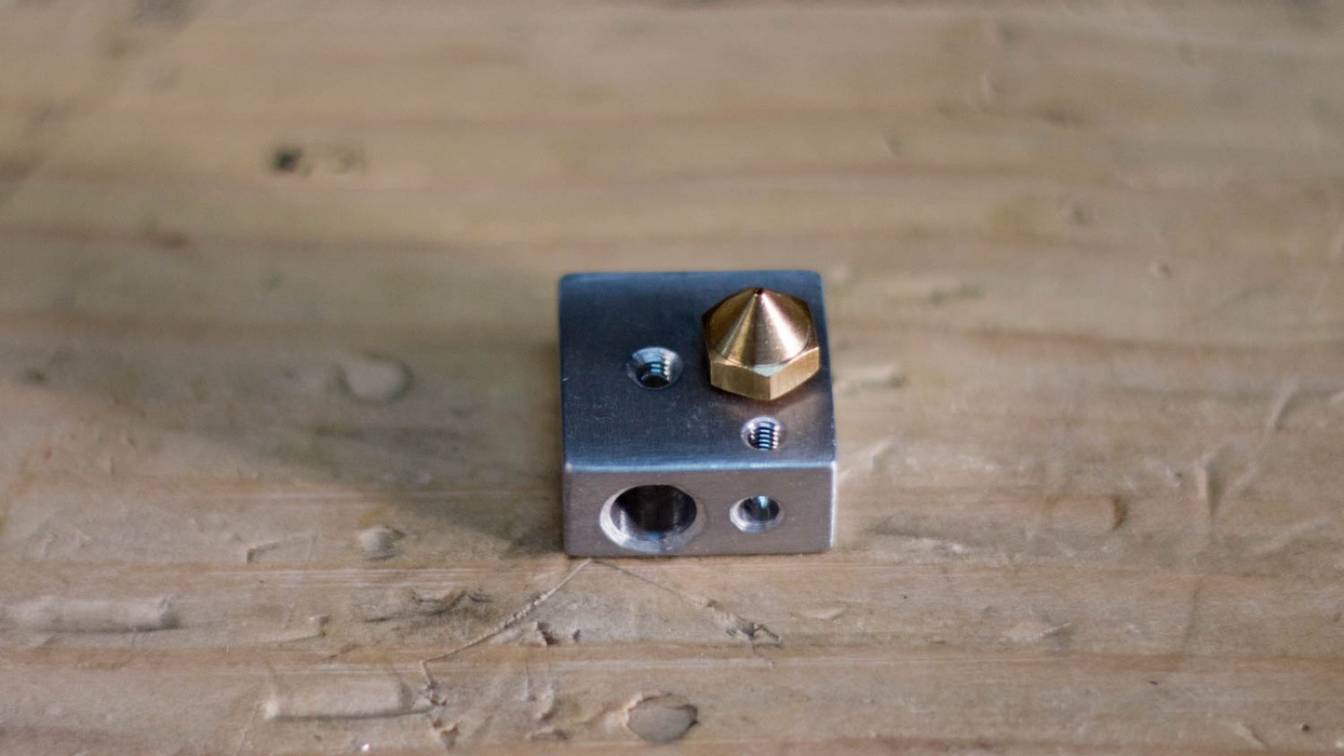

A hotend is not a nozzle: the nozzle is one part of it. Prusa Research defines the hotend as the nozzle, heat break, heatsink, heater block, heater cartridge and thermistor cartridge, plus a collet clip and PTFE (Teflon) tube. Replace the nozzle when it is worn, clogged or the wrong size, and the heater or sensor when the hotend stops heating or reads the wrong temperature.
Is a hotend the same as a nozzle?
No. A hotend is the assembly that melts filament; the nozzle is only its tip, the part that sets line width and wears out. Around it sit a heater block, heater, temperature sensor, heat break and a heatsink with its fan. Bambu Lab uses both words for one part, because it sells nozzles only as whole hotends.
On E3D V6- and MK8-style hotends, the nozzle is a separate part that screws into the heater block and is sold on its own. E3D sells V6 nozzles apart from its V6 hotend kit, and Micro Swiss lists its M6x1.0 MK8 nozzle as fitting the Creality Ender 3 family.
Bambu Lab hotend vs nozzle
On Bambu Lab printers there is no loose nozzle tip to buy. Bambu Lab’s nozzle guide opens with “Nozzle, also called the hotend”. Its X1 guide says the hotends “are designed as a single unit, incorporating the heatsink, throat, heater block, and nozzle.” The smallest replacement part is that unit, listed in the box as “Hotend with Nozzle” or “Hotend”.
What are the parts of a 3D printer hotend?
A 3D printer hotend has a nozzle, a heater block that holds it, a heater and a temperature sensor (thermistor or PT1000) in that block, a heat break that stops heat climbing, and a heatsink cooled by its own fan. Many add a silicone sock. PTFE-lined designs also run a plastic tube down to the nozzle.
The table lists the parts from the tip up.
| Part | What it does | When you replace it |
|---|---|---|
| Nozzle | The opening the plastic leaves through; its diameter sets the line width | Worn by abrasive filament, clogged beyond clearing, or for another size or material (signs of nozzle wear) |
| Heater block | Holds the nozzle, heater and sensor; Prusa Research says it “is attached to the rest of the hotend by the heatbreak” | Rarely on its own. Bambu Lab includes one in every hotend; on an E3D V6 it changes when you fit another block, such as E3D’s plated copper one |
| Heater | Heats the block: a cartridge (24 V, 40 W on the Original Prusa MK3/S, per Prusa Research) or a flat ceramic heater (48 W on the Bambu Lab X1 Carbon, per Bambu Lab) | When the hotend stops heating or heats abnormally |
| Temperature sensor (thermistor, or a PT1000 or PT100 platinum sensor) | Reports the block temperature to the firmware, which holds the setpoint and watches for thermal runaway | When the printer shows 0 °C or a temperature error (Bambu Lab says 0 °C can mean damaged thermistor wires), or to print hotter |
| Heat break | The thin tube between the hot block and the cooled heatsink; it stops heat travelling up the filament | When it is sheared or bent: E3D warns that overtightening a V6 nozzle risks “shearing either the nozzle or HeatBreak.” On one-piece designs it comes with the nozzle |
| Heatsink | Keeps the top of the hotend cool and mounts it to the printer | Rarely on its own. Prusa Research documents replacing it on the MK4 and MK3.9; Bambu Lab includes one in every hotend |
| Heatsink fan (hotend fan) | Cools the heatsink; Prusa Research says a heatsink “must have a hotend fan blowing air through its fins” | When it stops or runs at the wrong speed. Bambu Lab says a fan fitted backwards can cause “abnormal hotend fan speed or frequent plugging” |
| Silicone sock | Insulates the block so the part-cooling fan does not cool the nozzle, and keeps plastic off it | When it is cracked, torn, stretched or brittle, or plastic keeps building up around the hotend (Bambu Lab’s list) |
| PTFE liner (PTFE-lined hotends only) | A plastic tube down to the nozzle; E3D’s Lite6 has a “full length PTFE liner” | When heat damages it; E3D says a cooked Lite6 liner swaps out “quickly and easily.” All-metal hotends have none |
Designs bundle these differently. E3D’s V6 All-Metal HotEnd kit ships every part separately, while E3D’s Revo combines heater and thermistor in one “HeaterCore”. Choosing a hotend for engineering filaments covers all-metal vs PTFE-lined and how each part sets the temperature limit.
If a replacement heater or sensor differs from the original, such as another thermistor type or a PT1000, set the new type in the firmware before you heat the hotend. Thermal-runaway protection depends on a correct reading; Klipper heater verification explains how it works.
What is the difference between a hotend and a complete hotend?
On the Bambu Lab X1 Carbon, P1P and P1S, a hotend is the metal unit of nozzle, heater block, heat break and heatsink. A complete hotend is that unit with the ceramic heater, thermistor, hotend fan, silicone sock and retaining clip fitted. Buy the hotend for a worn nozzle, the complete hotend when the heater or thermistor has failed.
Both are options under Type on the “Bambu Hotend - X1C” and “Bambu Hotend - P1 Series” store listings. Per those listings and Bambu Lab’s wiki:
| Item | Hotend | Complete hotend |
|---|---|---|
| Nozzle, heater block, heat break, heatsink (one unit) | Yes | Yes |
| Ceramic heater and thermistor | No: move yours across | Yes, fitted |
| Hotend fan | No: move yours across | Yes, fitted |
| Silicone sock and retaining clip | Yes, loose | Yes, fitted |
| Thermal grease | Yes | Not listed |
| M3-14 step screws | 2 | 2 |
Bambu Lab calls the plain hotend “cheaper to replace, as the electronics can be re-used”. The complete hotend is “a bit more expensive” but fits in one step: unplug three connectors and remove two screws. Moving parts across means pulling the heater and thermistor out of old thermal grease. If it has hardened, Bambu Lab says not to force them: let alcohol soften the grease for about 5 minutes.
The complete hotends are series-specific. The X1 Series version fits the X1 and X1 Carbon, not the X1E, and the P1 Series version fits the P1P and P1S. Bambu Lab notes the heater and thermistor connectors may differ between the two.
Other makers use “complete” loosely. E3D’s High Flow ObXiDian 500 Complete HotEnd for Bambu Lab printers lists only “1 x Assembled” hotend in the box, so read the contents list, not the product name.
Which Bambu Lab part to buy for which fault
The A1, A2L, H2, P2S and X2D printers have no complete hotend. The heater and thermistor stay on the toolhead in a “hotend heating assembly” that the hotend latches into, a design Bambu Lab says enables “easy separation of the thermal and electronic components of the hotend.” Printers are listed alphabetically.
| Printer | Worn, clogged or wrong-size nozzle | Heater or thermistor fault |
|---|---|---|
| A1, A1 mini | Bambu Hotend - A1/A2 | Hotend Heating Assembly - A1 Series |
| A2L | Bambu Hotend - A1/A2 | Hotend Heating Assembly - A2L |
| H2C | Left: Bambu Hotend - H2/P2S/X2D. Right: H2C Induction Hotend | Left: Hotend Heating Assembly - H2D/H2C (Left). Right: Induction Heating Assembly |
| H2D | Bambu Hotend - H2/P2S/X2D | Hotend Heating Assembly - H2D/H2C, Left or Right version |
| H2S | Bambu Hotend - H2/P2S/X2D | Hotend Heating Assembly - H2S |
| P1P, P1S | Bambu Hotend - P1 Series, type Hotend | Ceramic Heater & Thermistor 3 pcs - P1 Series (one module), or the Complete Hotend |
| P2S | Bambu Hotend - H2/P2S/X2D | Hotend Heating Assembly - P2S |
| X1, X1 Carbon | Bambu Hotend - X1C, type Hotend | Ceramic Heater 3 pcs - X1C or Thermistor 3 pcs - X1C (not for the X1E), or the Complete Hotend |
| X2D | Bambu Hotend - H2/P2S/X2D | X2D hotend heating assembly, sold as separate left and right parts |
Bambu Lab’s reasons to replace a heating assembly: the hotend no longer heats or heats abnormally, the latch no longer holds the hotend, or the assembly is encased in plastic after a failed print. The H2D’s left and right assemblies “are not interchangeable”, and A1 and H2D assemblies are not compatible.
Check the repair before printing: Bambu Lab’s guides heat the hotend to 100 °C (A1) or 220 °C (H2D) and confirm the reading rises. If the new hotend is a different size or material, enter it on the printer’s screen: Bambu Studio’s nozzle field is display-only.
Which hotends have the nozzle and heat break in one part?
Bambu Lab hotends, the E3D Revo and Prusa Research’s Prusa Nozzle join the nozzle and heat break in one part, so the nozzle changes cold. On E3D V6- and MK8-style hotends they are separate: the nozzle screws into the heater block against the heat break and is tightened hot.
- Bambu Lab. On the X1 Carbon and P1 series, “the nozzle is integrated into the heatblock and connected to the heatsink via a thin metal tube”, and the hotend “can be installed when cold.”
- E3D Revo. The nozzle and HeatBreak “are integrated into a single unit”, unscrewed “with your fingers at room temperature.”
- Prusa Nozzle. On Prusa Research’s Nextruder printers (MK4, MK3.9, XL and CORE One families), it “integrates the heatbreak directly into the nozzle, eliminating the need to preheat the hotend for installation.”
- E3D V6 and MK8 style. For a brass V6 nozzle, E3D says to heat the hotend to 285 °C and tighten to 2 Nm.
The nozzles do not cross over. A Revo hot side is always “a HeaterCore and Revo Nozzle”, and Prusa Research offers a Nextruder V6 Nozzle Adapter so its printers can take E3D V6 nozzles.
What is the hot end vs the cold end?
“Cold end” has two meanings. The open-source RepRap project uses “cold end” for the extruder drive, which “forces the raw material … into the hot end”; the hot end “melts the filament.” E3D uses the terms inside the hotend: the heat break splits it into a heated “hot side” and a cooled “cold side” that is “normally attached to the printer.”
Bambu Lab uses the second meaning: its nozzle guide calls the fan-cooled top of the hotend the “Cold End”, which “keeps the filament solid until it enters the melting zone.” So check which one a parts listing means: an extruder drive and a heatsink are different purchases.
Where the drive sits depends on the printer. On the Original Prusa MINI the extruder motor is fixed to the frame and pushes filament through a PTFE tube to the print head. On a direct-drive printer it rides on the toolhead, which is what the Ender 3 direct drive conversion changes.
What is the difference between a hotend and a toolhead?
The toolhead is everything on the moving carriage; the hotend is one module in it. Prusa Research lists its i3 print head as “a hotend w/nozzle, hobbed pulley, idler, a nozzle fan (print fan), hotend fan, P.I.N.D.A.-probe, filament sensor, and extruder motor.” Bambu Lab calls the hotend “the toolhead module’s core component.”
Names vary by maker. Prusa Research calls the whole i3 print head the “extruder”, but on the MINI uses “extruder” for the drive motor alone. A worn nozzle or a failed heater never needs a new toolhead.
Sources
- Prusa Knowledge Base, Hotend (glossary) (accessed October 30, 2026)
- Prusa Knowledge Base, Heater block (glossary) (accessed October 30, 2026)
- Prusa Knowledge Base, Heater cartridge (glossary) (accessed October 30, 2026)
- Prusa Knowledge Base, Heatsink (glossary) (accessed October 30, 2026)
- Prusa Knowledge Base, Extruder (i3) (glossary) (accessed October 30, 2026)
- Prusa Knowledge Base, Print head (glossary) (accessed October 30, 2026)
- Prusa Knowledge Base, Extruder / Extruder motor (Mini) (glossary) (accessed October 30, 2026)
- Prusa Knowledge Base, Prusa Nozzle types for Nextruder printers (accessed October 30, 2026)
- Prusa Knowledge Base, How to replace a hotend heatsink (MK4 / MK3.9) (accessed October 30, 2026)
- Bambu Lab Wiki, Replace the Hotend with Nozzle/Ceramic Heater/Thermistor/Hotend Fan (X1 Series) (accessed October 30, 2026)
- Bambu Lab Wiki, Complete Hotend Assembly and Related Components Replacement Guide for P1 Series (accessed October 30, 2026)
- Bambu Lab Wiki, Introduction to Bambu Nozzles (accessed October 30, 2026)
- Bambu Lab Wiki, Hotend Replacement for A1 Series (accessed October 30, 2026)
- Bambu Lab Wiki, A1 Series Hotend Heating Assembly Replacement Guide (accessed October 30, 2026)
- Bambu Lab Wiki, Replace H2D Hotend (accessed October 30, 2026)
- Bambu Lab Wiki, Replace H2D/H2C Hotend Heating Assembly (accessed October 30, 2026)
- Bambu Lab Wiki, Replacing the silicone sock for hotend (accessed October 30, 2026)
- Bambu Lab store (EU), Bambu Hotend - X1C (accessed October 30, 2026)
- Bambu Lab store (EU), Bambu Hotend - P1 Series (accessed October 30, 2026)
- Bambu Lab store (EU), Bambu Hotend - A1/A2 (accessed October 30, 2026)
- Bambu Lab store (EU), Bambu Hotend - H2/P2S/X2D (accessed October 30, 2026)
- Bambu Lab store (EU), Ceramic Heater 3 pcs - X1C (accessed October 30, 2026)
- Bambu Lab store (EU), Thermistor 3 pcs - X1C (accessed October 30, 2026)
- Bambu Lab store (EU), Ceramic Heater & Thermistor 3 pcs - P1 Series (accessed October 30, 2026)
- Bambu Lab store (EU), Hotend Heating Assembly - A1 Series (accessed October 30, 2026)
- Bambu Lab store (EU), Hotend Heating Assembly - A2L (accessed October 30, 2026)
- Bambu Lab store (EU), Hotend Heating Assembly - H2D/H2C (accessed October 30, 2026)
- Bambu Lab store (EU), Hotend Heating Assembly - H2S (accessed October 30, 2026)
- Bambu Lab store (EU), Hotend Heating Assembly - P2S (accessed October 30, 2026)
- 3DJake, Bambu Lab Hotend Heating Assembly, X2D - left (accessed October 30, 2026)
- E3D Blog, Introducing RapidChange Revo (September 28, 2021) (accessed October 30, 2026)
- E3D, E3D Classics Support: V6 Nozzle (accessed October 30, 2026)
- E3D, V6 All-Metal HotEnd (accessed October 30, 2026)
- E3D Blog, Lite6: The low-cost, high-quality HotEnd for everyone! (accessed October 30, 2026)
- E3D, High Flow ObXiDian 500 Complete HotEnd for Bambu Lab X1C, P1P, P1S & X1E (accessed October 30, 2026)
- Micro Swiss, MK8 M2 Hardened High Speed Steel Nozzle WS2 coated (accessed October 30, 2026)
- RepRap Wiki, Extruder (accessed October 30, 2026)