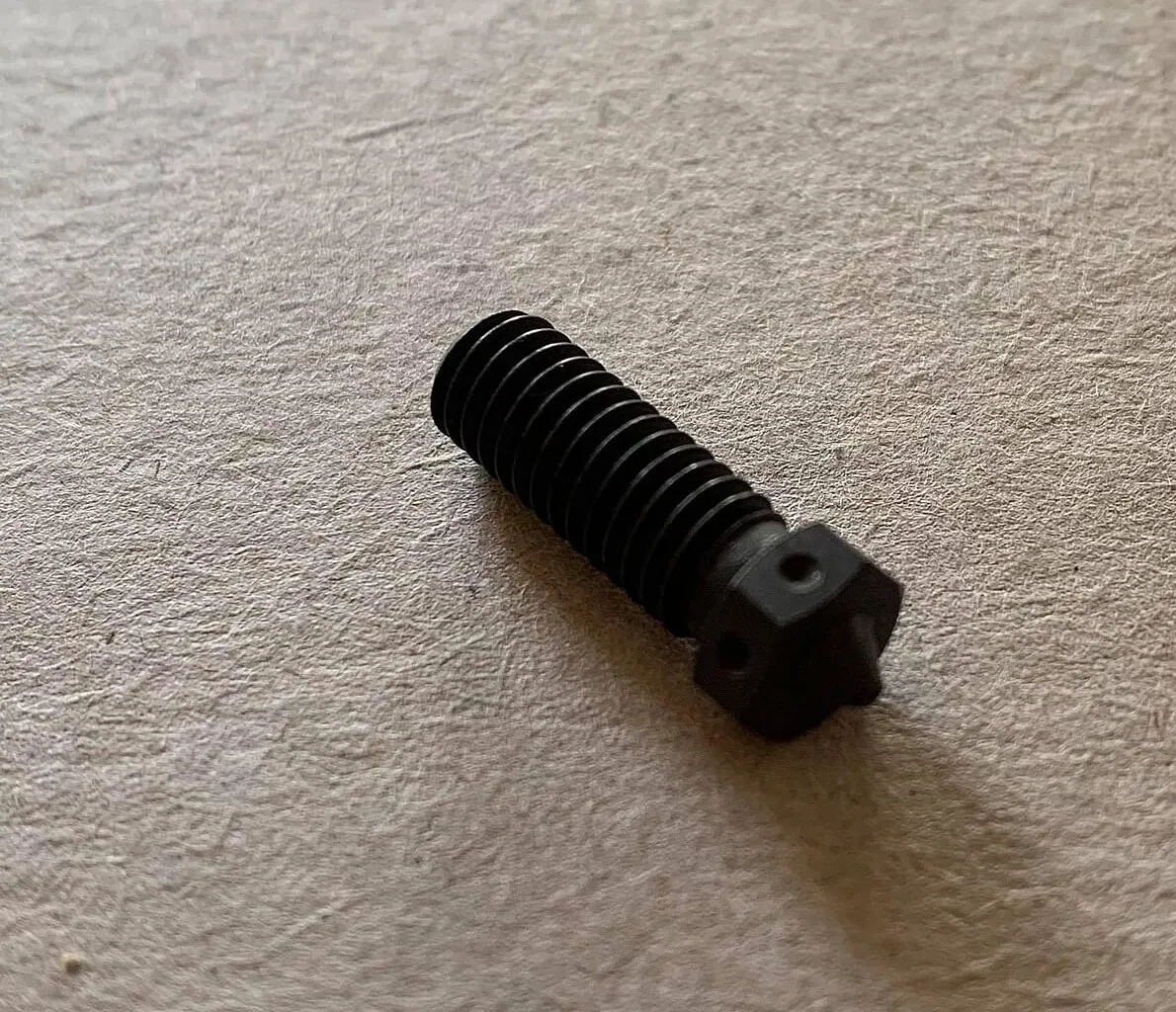
Brass nozzles wear out fast on carbon fiber, glass fiber and other filled filaments. Every wear-resistant material trades something for its hardness: heat conduction, temperature limit or price. This page compares the material classes, with an example product for each and what its maker claims.
Wear-resistant nozzles come in six main material classes: hardened steel, tungsten carbide, ruby-tipped, coated copper alloy with a steel insert (such as E3D’s ObXidian), polycrystalline diamond, and stainless steel at the low end. All of them outlast brass on abrasive filament. They differ in heat conduction, temperature limit and price. Prices run from about £15 to over £75.
What are 3D printer nozzles made of?
Most nozzles are brass, which conducts heat well and machines easily but wears fast on abrasive filament. The alternatives are harder materials, alone or combined with a more conductive body. E3D describes its brass nozzles as suited to “standard non-abrasive applications”. For anything abrasive, its hardened steel nozzle is “suitable for abrasive filaments such as wood fills, glitter fills, and metal fills.”
Nozzle materials compared
The table compares the material classes on the two properties that matter most: how well the material conducts heat, and how its makers rate it against abrasive filament. Rows are sorted by thermal conductivity, highest first. Conductivity figures are for the base material, from the sources listed.
| Material class |
Thermal conductivity (W/m·K) |
Wear claim from its maker |
Example product |
Stated maximum temperature |
Price |
| Polycrystalline diamond (PCD) |
543 |
“2 to 8 times the life of tungsten carbide” |
DiamondBack V6 (sold by E3D) |
“should not exceed 300 Celsius” |
£76.00 |
| Plated copper |
390 to 401 (copper) |
“Non-abrasive applications” only |
E3D V6 Plated Copper |
500 °C |
£11.55 |
| Brass |
111 to 120 |
“Standard non-abrasive applications” |
E3D V6 Brass |
300 °C |
£5.20 |
| Tungsten carbide |
About 110 |
“50% increase in lifespan” over hardened steel |
Bambu Lab Tungsten Carbide Hotend (H2, P2S, X2D) |
350 °C |
€59.99 |
| Copper alloy with hardened steel insert, coated (ObXidian) |
Not stated |
“Orders of magnitude higher than any other E3D nozzle” |
E3D Revo ObXidian |
300 °C |
£48.50 |
| Hardened steel |
15.8 (A2 tool steel, room temperature) to 54 (carbon steel) |
Suitable for wood, glitter, metal and glow fills |
E3D V6 Hardened Steel |
500 °C; abrasives not above 350 °C |
£15.40 |
| Stainless steel |
14.4 (type 304) |
Wears “quickly” on abrasives, per Bambu Lab |
Bambu Lab Hotend, P1 Series, 0.2 mm stainless |
320 °C |
€15.99 |
| Ruby tip |
Not stated |
No wear after 8 kg of carbon fiber, in its maker’s test |
Olsson Ruby (3D Verkstan) |
300 °C; High Temp version 500 °C |
From $90 |
Prices are from each seller’s store on October 1, 2026, in its own currency, and are not directly comparable. E3D’s exclude VAT, and Bambu Lab’s are the EU store’s. Tungsten carbide’s conductivity is a secondary figure from Wikipedia, citing Blau’s Wear of Materials. The steel range is wide because tool steels conduct far less heat than plain carbon steel.
Brass vs hardened steel nozzle: the differences
Brass conducts heat several times better than hardened steel and costs less, but it wears out quickly on abrasive filament. Hardened steel resists wear and runs hotter: E3D rates its hardened steel nozzle to 500 °C, against 300 °C for its brass one. The cost is heat transfer, which can mean a higher print temperature for the same result.
Do hardened steel nozzles print differently than brass?
They can, because they move heat into the filament less efficiently. Prusa Research says hardened steel “has different thermal conductivity properties than brass”, so you “may need to adjust your printing settings and increase the hotend temperature by about 5°C”. E3D says hardened steel nozzles “can require you to bump up your HotEnd temperature by around 10 degrees”.
Temperature offset when switching from brass to steel
Start 5 °C hotter, as Prusa Research suggests. If extrusion still looks starved, go up toward the 10 °C E3D gives. Coated copper-alloy designs such as ObXidian avoid most of the offset. E3D says ObXidian’s “copper-alloy construction” lets you keep your brass profile. Bambu Lab publishes no offset between its stainless and hardened steel nozzles.
Nozzle thermal conductivity explained
Thermal conductivity is how well a material moves heat. A nozzle that conducts well melts filament evenly and keeps up at higher flow, so it needs less temperature to print the same. E3D notes that “copper has more than three times the thermal conductivity of brass”. Steel conducts far less, which is the source of the temperature offset above.
What filaments wear out nozzles?
Any filament with hard particles in it wears a nozzle. Bambu Lab’s filament guide lists “carbon fiber or glass fiber-reinforced materials, or particle-filled materials”, naming glow, marble and sparkle PLA, and says not to use stainless steel or brass for them, because “their hardness is insufficient, so they wear out quickly.” Polymaker says its glow PLA needs a hardened nozzle “because glow additives are highly abrasive.”
Does carbon fiber filament ruin nozzles?
It ruins brass ones. In CNC Kitchen’s 2019 test, carbon-fiber PETG wore a cheap brass nozzle’s tip away over 360 g of filament. The orifice stayed the same size, but the nozzle got shorter, and the first layer grew thicker as a result. The same test found “more or less no wear” after 330 g of glow filament, so the wear rate depends heavily on the filler.
What nozzle do I need for abrasive filament?
For abrasive filament at normal temperatures, a hardened steel nozzle is the baseline that Bambu Lab requires, and the harder materials last longer. For filled filaments printed above 350 °C, hardened steel no longer qualifies. E3D says its hardened steel nozzle is “not suitable for printing abrasive filaments at temperatures above 350°C.” Above that, the Olsson Ruby High Temp is the only nozzle listed here rated for both heat and wear. Bondtech expects its CHT BiMetal, with a hardened steel insert, to reach 430 °C, but says it is still testing.
How to choose a nozzle material for engineering filaments
Match the nozzle to the filler and the temperature:
| Filament |
Temperature |
Nozzle classes that fit |
| Unfilled PLA, PETG, ABS, PC, nylon |
Up to 300 °C |
Any, including brass |
| Carbon- or glass-filled, glow, marble |
Up to 300 °C |
Hardened steel, ObXidian, tungsten carbide, ruby, PCD |
| Carbon- or glass-filled |
300 to 350 °C |
Hardened steel, tungsten carbide (Bambu Lab’s is rated to 350 °C), ruby High Temp |
| Unfilled PEEK, PEI (ULTEM) |
350 to 480 °C |
Plated copper, hardened steel, ruby High Temp |
| Carbon-filled PEEK |
Above 350 °C |
Ruby High Temp |
3DXTECH lists “No special concerns” for the nozzle on its unfilled PEI 9085, which is why plated copper fits there. Check each nozzle’s own limit against the top of your material’s range.
Ruby vs tungsten carbide nozzles
Both resist wear far better than hardened steel. Tungsten carbide is a solid hard metal that conducts heat about as well as brass, by West3D’s description. A ruby nozzle sets a synthetic ruby tip into a brass body. 3D Verkstan reports its Olsson Ruby showed no wear after 8 kg of carbon fiber filament, against 0.3 kg for brass, 1 kg for stainless and 4 kg for hardened steel. That is the maker’s own test.
The ruby tip has one weakness. 3D Verkstan warns that it “is very hard but can chip if it gets hit sharply”, and that a wire brush strand “may get lodged in the orifice and crack the ruby.” The standard Olsson Ruby is rated to 300 °C, and its High Temp version to 500 °C. Neither tungsten carbide listing checked here warns of chipping.
Tungsten carbide vs ruby nozzle: worth it?
They are worth it if you print abrasive filament often enough to wear through hardened steel. Bambu Lab claims its tungsten carbide nozzle gives “a 50% increase in lifespan” over hardened steel, and DiamondBack claims PCD lasts 2 to 8 times as long as tungsten carbide. For occasional carbon-fiber prints, hardened steel at a fraction of the price is usually enough.
ObXidian nozzle vs hardened steel
ObXidian is E3D’s copper-alloy nozzle with a hardened steel insert and a coating it calls E3DLC. It conducts heat better than plain hardened steel, so it keeps brass settings. E3D claims wear resistance “orders of magnitude higher than any other E3D nozzle”, but rates the Revo version to 300 °C, against 500 °C for its hardened steel nozzle.
E3D also warns that some aggressive fillers, “including but not limited to Polymaker’s Fiberon range (PA612-CF, PA6-CF, PA6-GF and PA12-CF), can cause significant wear on even ObXidian nozzles.”
Copper alloy nozzles for high-temperature printing
Copper-based nozzles suit high temperatures when the filament is not abrasive. E3D rates its plated copper nozzle to 500 °C for “high-temperature, non-abrasive applications”. Bondtech’s CHT BiMetal adds a “hardened Vanadium steel” insert to a copper-alloy body. Bondtech says it expects “up to 430C” and was still testing.
Nozzles for PEEK and ULTEM printing
PEEK and PEI (ULTEM) print at 350 °C and above, which rules out every nozzle rated to 300 °C, including brass, ObXidian and PCD. For unfilled grades, plated copper or hardened steel rated to 500 °C fits. For carbon-filled PEEK above 350 °C, E3D’s hardened steel is excluded by its own rating, leaving the 500 °C ruby. The hotend, sensor and printer also have to reach the temperature.
Best nozzle for Bambu Lab printers and abrasives
The Bambu Lab X1C, P2S, X2D and H2 series ship with hardened steel nozzles, which meet Bambu Lab’s requirement for abrasive filament. The P1S and A1 ship with stainless steel and need a hardened steel hotend first. Bambu Lab’s P1S upgrade guide warns about its stainless parts: “For the most abrasive filaments, the nozzle can be damaged after a single print.”
Bambu Lab sells hardened steel hotends for the P1 series at €15.99, or €35.99 complete, and a tungsten carbide hotend for the H2, P2S and X2D. The Bambu Lab hub lists third-party hotends for the X1 and P1 series. On any of them, the printer’s own temperature limit still applies.
How to tell if your nozzle is worn out
A worn nozzle shows up as uneven extrusion or a change in first-layer height. Bambu Lab says worn nozzles “develop irregular or enlarged orifices, causing uneven filament flow, poor layer adhesion, and reduced print quality.” CNC Kitchen found a different pattern with carbon fiber: the tip wore shorter, so the first layer grew thicker. Look at the tip for missing material and rounded edges. Signs of nozzle wear covers the symptoms and how to test a nozzle against a new one.