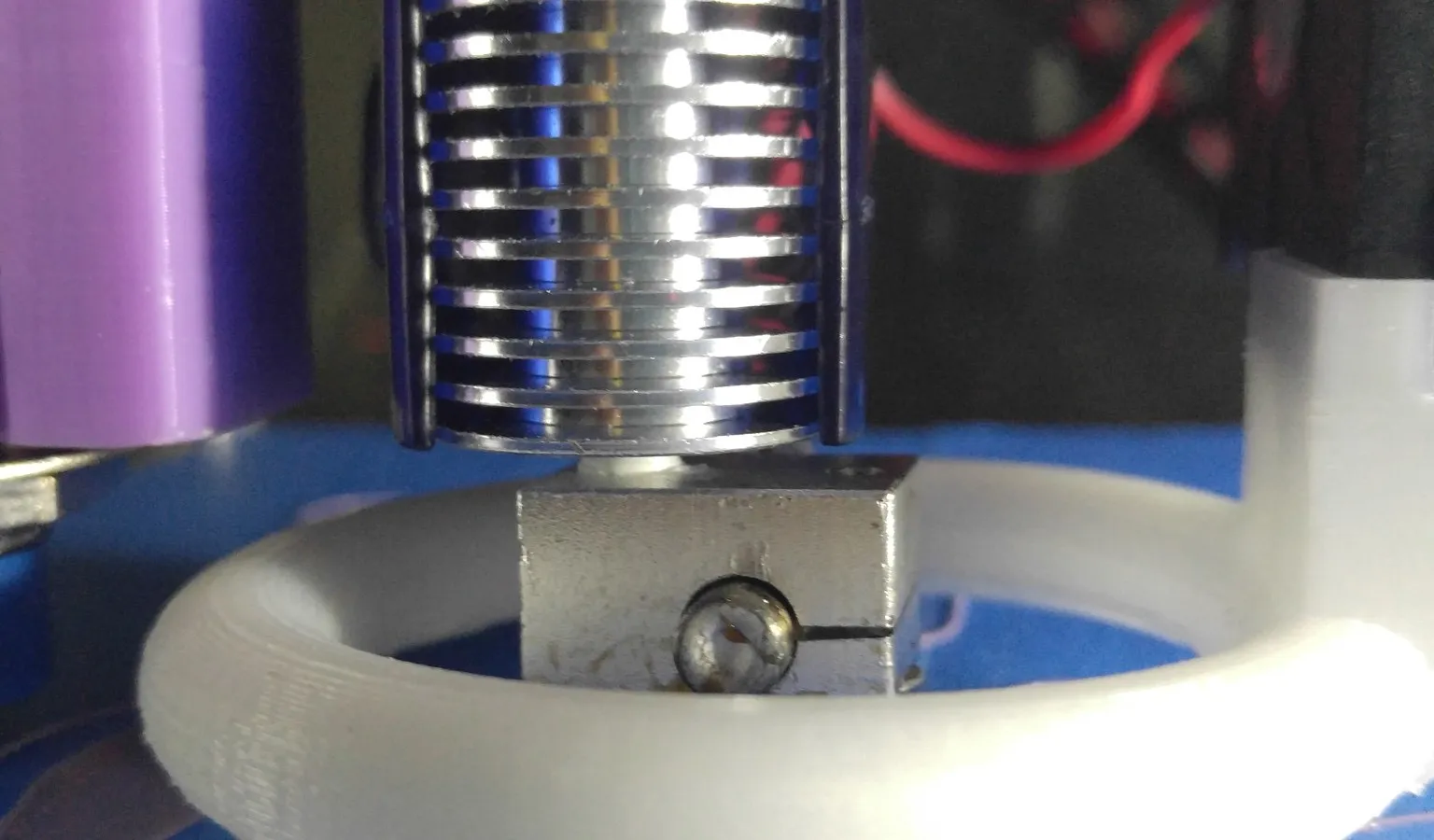
Use a hardened steel nozzle for any filament with hard particles in it: carbon or glass fiber, glow-in-the-dark pigment, metal powder, or marble and sparkle fillers. Plain PLA, PETG, ABS, ASA, TPU, PC and unfilled nylon do not need one, though they print through it a few degrees hotter.
You need a hardened steel nozzle when the filament carries particles harder than brass: carbon fiber (CF), glass fiber (GF), glow-in-the-dark pigment, metal powder, or mineral and glitter fillers such as marble and sparkle PLA. Unfilled PLA, PETG, ABS, ASA, TPU, PC and nylon do not need one. A hardened nozzle still prints them, though Prusa Research and E3D say it can need 5 to 10 °C more.
Which filaments need a hardened steel nozzle?
Filaments filled with hard particles need a hardened steel nozzle. Bambu Lab lists it as required for PLA-CF, PETG-CF, ABS-GF, PA-CF, PAHT-CF, PET-CF, PPA-CF, PPS-CF and glow PLA, and its notes name marble and sparkle PLA. Prusa Research adds metal-filled filaments such as bronze-filled PLA. Unfilled PLA, PETG, ABS, ASA, TPU, PC and nylon do not need one.
The table collects what filament and printer makers say about each type. Rows are grouped by the answer (required, sources disagree, not required), then listed alphabetically.
| Filament |
Hardened steel nozzle |
What the makers say |
| ABS-GF, ABS-CF |
Required |
Bambu Lab: “Required” |
| Glow-in-the-dark (strontium aluminate) |
Required |
Bambu Lab: “Required” for PLA Glow. Polymaker says its Glow PLA “requires a hardened nozzle when printing regularly” |
| Marble, sparkle and glitter PLA |
Required |
Bambu Lab names PLA Marble and PLA Sparkle among the filaments that need hardened steel. E3D counts glitter fills as abrasive |
| Metal-filled (bronze, brass, copper or steel powder) |
Required |
Prusa Research names Bronzefill and Brassfill as abrasive. colorFabb says steelFill is “quite abrasive to brass nozzles” |
| PA-CF, PA-GF, PA6-CF, PAHT-CF (filled nylon) |
Required |
Bambu Lab: “Required”. Polymaker: “0.4mm+ hardened nozzle required” for Fiberon PA6-CF20 |
| PET-CF, PET-GF |
Required |
Bambu Lab: “Required” |
| PETG-CF, PETG-GF |
Required |
Bambu Lab: “Required”. Polymaker: “0.4mm+ hardened nozzle required” for Fiberon PETG-rCF08 |
| PLA-CF, PLA-GF |
Required |
Bambu Lab: “Required” |
| PPA-CF, PPS-CF |
Required |
Bambu Lab: “Required”, printed at 285 to 320 °C and 310 to 340 °C |
| Wood-filled PLA |
Sources disagree |
Bambu Lab’s filament table: “Not Required”, but its nozzle guide lists wood under hardened steel. Prusa Research marks wood-infused filament for a hardened 0.4 mm nozzle |
| ABS, ASA |
Not required |
Bambu Lab: “Not Required” |
| Nylon, unfilled (PA6, PA12, CoPA) |
Not required |
Bambu Lab lists PA (nylon) among the non-abrasive filaments its stainless steel P1S hotend suits. Prusa Research’s nozzle table asks for no hardened nozzle |
| PC |
Not required |
Bambu Lab: “Not Required” |
| PETG |
Not required |
Bambu Lab: “Not Required” |
| PLA, including matte, silk and metallic-look PLA |
Not required |
Bambu Lab: “Not Required” |
| PVA, BVOH |
Not required |
Bambu Lab: “Not Required” |
| TPU |
Not required |
Bambu Lab: “Not Required” |
Bambu Lab’s page contradicts itself on marble: its notes list PLA Marble with the hardened-steel filaments, but its table row says “Not Required”. The notes are the more specific instruction, so treat marble as abrasive.
Read the datasheet, not the name. Bambu Lab counts its PLA Metal as standard PLA with no hard metallic filler, while colorFabb’s steelFill is loaded with steel. When the label does not say, Prusa Research’s advice is to ask the filament maker.
Wood works the same way. Polymaker’s Wood PLA is foamed PLA “without actual wood powder”. For wood filament with real wood in it, Prusa Research’s table calls for a hardened nozzle at 0.4 mm, and CNC Kitchen warns that wood fibers “can also cause an early death” of a brass nozzle.
How fast does abrasive filament wear out a brass nozzle?
Within a spool, and sometimes within one print. Stainless steel wears quickly too, so fit the hardened nozzle before the first abrasive spool.
- Glow-in-the-dark. In CNC Kitchen’s 2023 test, 100 g of colorFabb glowFill took almost 0.5 mm off a brass nozzle tip, and 100 g of Tronxy’s rainbow glow filament 0.18 mm. dasFilament’s glow PLA caused “barely measurable wear”, so brands differ widely.
- Carbon-fiber PETG. In CNC Kitchen’s 2019 test, 360 g of colorFabb XT-CF20 wore a cheap brass tip shorter until the first layer grew thicker. CNC Kitchen expects the orifice to open up fast once wear reaches the internal taper.
- Polymaker’s carbon-fiber nylon and PETG. The datasheet for Fiberon PA6-CF20 says “the life of a brass nozzle would be approximately 9h”. Its store gives the same figure for Fiberon PETG-rCF08.
- Steel-filled. colorFabb says steelFill wears brass less than its carbon-fiber XT-CF20, but can affect print quality after 1.5 kg.
- Stainless steel. Bambu Lab shows a stainless nozzle worn out after 10 hours of PETG-CF and warns that “for the most abrasive filaments, the nozzle can be damaged after a single print.”
White pigment wears more slowly: CNC Kitchen found serious wear on a brass nozzle that had printed only standard materials for probably more than 1,000 hours, and names titanium dioxide in white filament as one source of wear. Signs of a worn nozzle shows what to check, and hardened steel vs stainless steel compares the two materials.
Do you need a hardened steel nozzle for PETG?
Not for plain PETG. Bambu Lab’s filament guide lists a hardened steel nozzle as “Not Required” for PETG, PETG HF and PETG Translucent. Carbon- or glass-filled PETG is different: Bambu Lab marks PETG-CF as “Required”, and Polymaker says its Fiberon PETG-rCF08 needs a 0.4 mm or larger hardened nozzle.
Bambu Lab prints PETG-CF at 240 to 270 °C, the same range as plain PETG, so no hotter hotend is needed: the hardware changes are the nozzle and the extruder gears. For its own PETG-CF, Bambu Lab lists a 0.4 mm hardened nozzle as “Recommended”. Glow-in-the-dark PETG counts as filled: CNC Kitchen says glow filaments almost always get their glow from strontium aluminate.
Do you need a hardened steel nozzle for nylon?
Not for unfilled nylon. Bambu Lab lists PA (nylon) among the non-abrasive filaments its stainless steel P1S hotend suits, and Prusa Research’s nozzle table asks for no hardened nozzle for nylon. Carbon- or glass-filled nylon (PA-CF, PA6-GF, PAHT-CF) does: Bambu Lab marks it “Required”, and Polymaker puts brass life on PA6-CF20 at about 9 hours.
What every nylon needs is heat. Polymaker gives 250 to 270 °C for its unfilled PolyMide CoPA, and Bambu Lab 260 to 300 °C for PA-CF and PAHT-CF. Polymaker says its PA6-CF20 needs an all-metal hotend that reaches 280 °C or higher. That rules out PTFE-lined hotends, as the hotend guide for engineering filaments explains.
Can you print PLA with a hardened steel nozzle?
Yes. A hardened steel nozzle prints plain PLA, and the Bambu Lab X1 Carbon ships with a 0.4 mm hardened steel nozzle. What changes is heat transfer: Prusa Research suggests raising the hotend about 5 °C, E3D says hardened steel nozzles can need around 10 °C more, and Prusa Research notes some standard materials cannot print as fast.
E3D explains why: the printer holds the temperature at its sensor, not in the plastic. A nozzle that passes heat on less well leaves the plastic cooler at the same setting. To move a PLA profile from brass to hardened steel:
- Add 5 °C. Raise the nozzle temperature 5 °C over your brass setting, Prusa Research’s figure.
- Go toward 10 °C if needed. If lines look thin or layers bond weakly, raise it further, up to the 10 °C E3D gives.
- Slow down if it starves. If it still under-extrudes on fast moves, lower the speed or the volumetric flow limit.
Leaving a hardened nozzle in full time is fine: Prusa Research calls its nickel-plated hardened nozzle “ideal for frequent switches between abrasive and non-abrasive materials”. The Bambu hardened steel nozzle guide covers the swap on Bambu Lab printers.
What are the disadvantages of a hardened steel nozzle?
A hardened steel nozzle conducts heat worse than brass, so it can need 5 to 10 °C more and may not print as fast. It also costs more: an E3D V6 0.6 mm hardened steel nozzle is about three times the price of the brass version. E3D rates its hardened steel for abrasives only to 350 °C.
It moves heat less well
Engineering ToolBox lists 111 to 120 W/m·K for common brasses and 43 W/m·K for a 1% carbon steel. Abrams Industries gives 15.8 W/m·K at room temperature for A2 tool steel, the grade Micro Swiss makes its MK10 hardened nozzle from. Brass moves heat roughly 2.5 to 7.5 times better than these steels. The cost is the temperature offset above and, per Prusa Research, slower printing of some standard filaments such as ABS. Neither Prusa Research nor E3D puts a number on the speed loss.
It costs more
Printed Solid, a US retailer, listed E3D’s V6 0.6 mm nozzle for 1.75 mm filament at $6.85 in brass and $19.85 in hardened steel on October 21, 2026.
Its limit for abrasives is lower than its heat limit
E3D rates its V6 hardened steel nozzle to 500 °C, but says it is “not suitable for printing abrasive filaments at temperatures above 350°C.” Micro Swiss says its M2 high-speed steel nozzle “can operate up to 450C without losing the hardness.” For filled filaments printed above 350 °C, the wear-resistant nozzle comparison covers the options.
Coated versions need gentler cleaning
Some hardened nozzles are plated or coated: Micro Swiss nickel-plates its A2 nozzle and adds a WS2 (tungsten disulfide) coating to its M2 one, and Prusa Research nickel-plates its hardened nozzle. For its coated nozzles, Prusa Research says to clean with a cloth outside and cleaning filament inside. It warns that “an acupuncture needle or a brass brush can damage the coating,” and advises against cold pulls on E3D’s ObXidian. Bambu Lab’s filament guide says to clear its own nozzles with an Allen key and a needle, a method not to carry over to a coated nozzle.
It still wears
Hardened steel slows wear but does not stop it. CNC Kitchen warns that “on a really bad day, even these can wear after a while”, and Bambu Lab says its tungsten carbide nozzle, compared with hardened steel, “shows significantly less wear, even after many kilograms of filament.”
What else do you need to print abrasive filament?
You need hardened extruder gears, a 0.4 mm or larger nozzle, and a feed path that can take the wear.
- Extruder gears. Bambu Lab says abrasive particles erode “the inner surfaces of the nozzle and extruder gears”, and that worn gears slip and under-extrude. Its P1S upgrade swaps in hardened steel gears with the hotend. E3D found the same wear on extruder hobs (the toothed drive gears) and sells hardened ones.
- Nozzle size. For fiber- and particle-filled filaments, Bambu Lab lists a 0.6 mm hardened nozzle as the first choice and 0.4 mm as the second. It says not to use 0.2 mm, because “the clogging risk is extremely high.”
- AMS and feed tubes. Bambu Lab warns that carbon fiber and glow filaments “can eventually grind down the internal PTFE feed channels” of its AMS (Automatic Material System). Polymaker says to avoid AMS systems with plastic gears or PTFE paths for its Glow PLA. AMS-compatible filaments covers the feed side.