Guide
Hotend silicone socks: what they do and their limits
A hotend silicone sock insulates the heater block so the part-cooling fan cannot pull its temperature around, and it keeps molten plastic off the block. You can print without one. Makers rate their socks to about 300 °C, and each sock fits only the hotend it was molded for.
Edited by 3D Printeray EditorsPublished Last verified 8 min read
In this section: Hotends(16)
On this page (7)
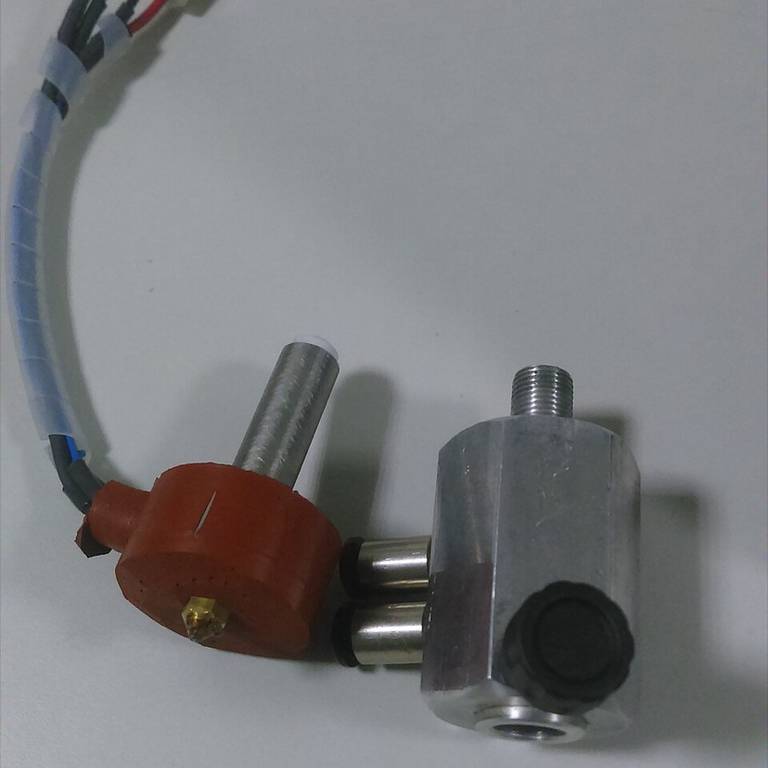

A hotend silicone sock is a molded silicone cover that fits over the heater block. It holds the block’s temperature steady when the part-cooling fan blows on it, keeps molten plastic from sticking, and cuts the heat radiating onto the print. Bambu Lab rates its socks to 300 °C printing temperatures, and each sock fits only the hotend it was molded for.
Do you need a silicone sock on a hotend?
A hotend prints without a silicone sock, but E3D includes one in its V6 kit and Bambu Lab fits one to its printers. E3D, Bambu Lab and Prusa Research all describe the sock as insulation that keeps the heater block’s temperature stable. Bambu Lab links a missing or damaged sock to temperature fluctuations and nozzle temperature errors.
What a silicone sock does
- Holds the temperature under the fan. E3D says a sock lets “a powerful unducted blower fan” point at the nozzle tip without dropping the nozzle temperature. Prusa Research calls temperature stability the sock’s “main function”.
- Keeps plastic off the block. Plastic that cannot build up on the hotend “can’t form a blob which drops off halfway through a print”, says E3D. Bambu Lab says a failed sock lets oozing filament through, “which can lead to clogging”.
- Cuts radiated heat. E3D says the silicone “stops heat radiating from the heater block onto the area being printed”. That helps tall, thin prints cool between layers.
- Protects the hotend. Prusa Research says it shields the hotend “in case the print detaches from the print surface”. E3D adds that socks “don’t make it safe to touch the hotend”.
What happens without one
Bambu Lab lists the HMS (Health Management System) error “Abnormality in the nozzle temperature control” and a measured temperature that drifts from the set point. A loose sock also lets cold air in and “could interfere with the printer’s wiping or leveling functions”. E3D credits the sock with “tighter, more easily tuned PID loops, and faster heat up times” (PID is the firmware’s heater control loop).
How much it matters depends on the setup. Slice Engineering names the factors:
- how much part-cooling air is blown, and how the ducts aim it
- the nozzle type and size
- the air temperature
- how sensitive the print is to plastic temperature
- the heater power available
If a Klipper printer reports heater errors with the sock off, refit the sock before loosening the heater verification checks.
What temperature can a hotend silicone sock handle?
A hotend silicone sock is usually rated to about 300 °C. Bambu Lab rates its socks to 300 °C printing temperatures, E3D says its silicone runs at a constant 300 °C without degrading, and Slice Engineering rates its Mako boot to 320 °C. E3D’s V6 datasheet is stricter: 260 °C for the V6 with the sock fitted.
| Sock | Figure | Maker’s wording |
|---|---|---|
| E3D V6 HotEnd, sock fitted | 260 °C | “Maximum operation temperature with sock fitted” (datasheet) |
| Bambu Lab Silicone Sock for Hotend, every variant | 300 °C | “rated to 300°C printing temperatures” |
| E3D silicone socks (2016 launch post) | 300 °C | Runs at a constant 300 °C “without degradation” |
| Slice Engineering Mako Silicone Boot | 320 °C | “a maximum temperature rating of 320°C” |
E3D publishes no figure for its Revo or Volcano socks, and Micro Swiss and Prusa Research publish none for theirs. A standard Revo stops at 300 °C anyway: E3D rates the 40 W HeaterCore and brass Revo nozzles to that printing temperature.
Past its rating a sock ages rather than melts. E3D says it brings “slow aging and eventually weakness and splitting”, and calls its socks “pretty usable up to 400°C, but with reduced life”.
Bambu Lab’s figures leave a gap. It lists a 350 °C maximum nozzle temperature for the Bambu Lab H2D, but sells one sock rated to 300 °C and gives no separate instruction for printing above 300 °C. If you print there, check the sock for the wear signs below more often.
What if you print hotter than the sock’s rating?
Hotend makers offer three routes:
- Run without the sock. E3D lists the V6 at 285 °C without the sock on its thermistor, and 485 °C with a PT100 sensor. Expect the temperature to sag more under the part-cooling fan.
- Use insulation that is not silicone. E3D’s SuperVolcano uses high-temperature fiberglass sleeving instead of a sock. Slice Engineering’s Convection Shield for the Mosquito Magnum+ and Prime is aluminum, held off the block by “a thin air gap and ceramic washers”, and rated for hotend temperatures up to 500 °C.
- Replace the sock more often. E3D’s figures above put 300 to 400 °C within reach, at the cost of faster aging.
Taking the sock off does not by itself let a hotend run hotter. The heater, sensor and firmware limit must all be rated for the target: see firmware temperature limits and choosing a hotend for engineering filaments. If you change the heater or thermistor, set the new sensor type in firmware before heating, so thermal-runaway protection reads correctly. Running past the printer maker’s limit is at your own risk and can affect the warranty (does upgrading void the warranty?).
Which silicone sock fits your hotend?
Socks are molded to one block shape, so buy the sock for your hotend, not for your printer brand. A third-party hotend takes its own maker’s sock. Rows are alphabetical.
| Hotend (printers) | Sock | Maker’s fit notes |
|---|---|---|
| Bambu Lab A-series (A1, A1 mini) | Bambu Lab “A1 Series” | An H2 hotend on an A1 needs the H2 sock |
| Bambu Lab A2L | Bambu Lab “A2L” | Its own variant |
| Bambu Lab H2 family (H2D, H2S, H2C left side) | Bambu Lab “H2D”, “H2S” or “H2C (Left Hotend)” | The H2S hotend and sock “are compatible with the H2D” |
| Bambu Lab H2C right side (induction hotends) | Bambu Lab “H2C (Right Hotend)” | Separate from the left-side sock |
| Bambu Lab P2S, X2D | Bambu Lab “P2S” or “X2D” | The wiki pictures one P2S/X2D sock, separate from the H2 sock |
| Bambu Lab X1/P1 (X1 Carbon, P1P, P1S) | Bambu Lab “X1C” or “P1 Series” | The wiki pictures one X1/P1 sock |
| Creality MK8-style block (Ender 3, Ender 3 Pro, Ender 3 V2, Ender 3 Max) | MK7/MK8/MK9 sock | See Ender 3 below |
| E3D Revo (Revo Six, Revo Micro, Revo Voron, Revo CR and other Revo hotends) | Revo nozzle socks and a HeaterCore sock | See Revo below |
| E3D V6 | V6 Silicone Socks, or V6 Socks Pro | Shaped for the cartridge-style block. The Pro covers most of the nozzle, for 0.15 and 0.25 mm nozzles |
| E3D Volcano | Silicone Socks for Volcano | V6 socks do not fit the Volcano, E3D said at launch |
| Prusa Nextruder (Core One, Core One L, XL, MK4/S, MK3.9/S) | Prusa Nextruder silicone sock | Set the sock to ON in the printer menu after fitting |
| Third-party hotends on Bambu Lab printers (E3D DiamondBack, Micro Swiss FlowTech and CHT, Slice Engineering Mako) | That maker’s own sock or boot | Micro Swiss’s CHT sock comes in an A1/H2 version and a P2S/X2D version |
Bambu Lab hotend socks
Bambu Lab sells all of its socks on one “Silicone Sock for Hotend” listing, three per pack: pick your printer under Printer Model. The A1 and A1 mini share one sock. The H2 sock follows the H2 hotend, even on an A1: Bambu Lab says that setup “requires the H2 series silicone sock”.
E3D Revo socks
A Revo hotend carries two socks. Each Revo nozzle has its own, colored by size: E3D’s brass nozzles come in pink (0.15 mm), yellow (0.25 mm), red (0.40 mm), blue (0.60 mm) and green (0.80 mm). The size is also engraved on the nozzle in case the sock is lost.
The HeaterCore, which holds the heater and thermistor, has a black sock of its own. Spares come as triple packs per color, or as a Fully Loaded Sock Pack with two socks per nozzle size and two for the HeaterCore.
Ender 3 hotend socks
Micro Swiss lists its MK7/MK8/MK9 sock 3-pack for the Creality Ender 3, Ender 3 Pro, Ender 3 V2 and Ender 3 Max. It says the sock “will keep your heater block clean and will help retain the heat”. It does not list the Ender 3 S1 or the Ender 3 V3 series. Its FlowTech hotends for the Ender 3 V3, V3 SE and V3 KE take separate FlowTech socks.
When should you replace a silicone sock?
Replace a sock when it is torn, loose, stretched, brittle or discolored. Replace it too when plastic keeps building up on the heater block. Those are Bambu Lab’s signs. It adds wear from rubbing on the nozzle wiper and suggests checking the sock after each nozzle cleaning.
E3D sells socks in threes because they “will eventually wear away or perish”, at a rate that depends on temperatures and materials. At launch it expected 100+ hours even in “quite abusive conditions”. It named failed prints that curl into the hotend’s path or come off the bed as the usual cause of damage.
How to fit a new silicone sock
- Power off and let it cool. Bambu Lab and Prusa Research both say to fit a sock with the printer off and the nozzle cool; Prusa Research says “fully cooled down to room temperature”. None of these makers describes fitting a sock over a hot block.
- Clean the block if needed. Prusa Research heats the nozzle to 250 °C for about five minutes and scrubs it with a brass brush, then lets it cool below 50 °C before fitting.
- Pull the old sock off. Hold it by both sides and pull downward. Bambu Lab’s P2S, X2D and A2L guides say to pull firmly, down and at an angle.
- Line up the wire slot. Bambu Lab says to put the wire groove on the correct side. E3D’s V6 socks have wiring cutouts on both sides.
- Push it on from the bottom. Push up until it fits snugly; E3D’s sock grips the block with hooks around its top. If it resists, do not force it: Prusa Research warns that too much force can bend the heatbreak.
- Check the fit. Bambu Lab says it should sit tight with no slant. On the A2L it must clear the surrounding plastic parts.
- Tell a Prusa printer. On Nextruder printers, go to LCD Menu > Settings > Hardware > Nextruder Silicone sock and set it to ON.
Sources
- Bambu Lab Wiki, Replacing the silicone sock for hotend (accessed October 30, 2026)
- Bambu Lab Wiki, P2S hotend and hotend silicone sock replacement (accessed October 30, 2026)
- Bambu Lab Wiki, X2D hotend and hotend silicone sock replacement (accessed October 30, 2026)
- Bambu Lab Wiki, A2L silicone sock and hotend replacement (accessed October 30, 2026)
- Bambu Lab store (EU), Silicone Sock for Hotend (accessed October 30, 2026)
- Bambu Lab store (EU), H2S (FAQ) (accessed October 30, 2026)
- Bambu Lab store (EU), H2D (specifications) (accessed October 30, 2026)
- E3D Help Centre, E3D Classics Support: V6 HotEnd (specifications and assembly) (accessed October 30, 2026)
- E3D Blog, Silicone socks: cleaner nozzles and sharper prints (August 13, 2016) (accessed October 30, 2026)
- E3D, V6 Silicone Socks (Pack of 3) (accessed October 30, 2026)
- E3D, V6 Socks - Pro (Pack of 3) (accessed October 30, 2026)
- E3D, Silicone Socks for Volcano (3 pack) (accessed October 30, 2026)
- E3D Blog, Finish your print quicker than ever before: the SuperVolcano has erupted (March 28, 2019) (accessed October 30, 2026)
- E3D, Revo Fully Loaded Sock Pack (accessed October 30, 2026)
- E3D, Revo Nozzle Triple Sock Packs (accessed October 30, 2026)
- E3D Help Centre, Revo Support: Brass Nozzle (accessed October 30, 2026)
- E3D Help Centre, Revo Support: 40W 104NT HeaterCore (accessed October 30, 2026)
- E3D Blog, Revo HeaterCore features (accessed October 30, 2026)
- E3D Blog, Revo nozzle features (accessed October 30, 2026)
- E3D, DiamondBack Silicone HeatSocks for Bambu Lab H2, P2, X2 & A2 (accessed October 30, 2026)
- Prusa Knowledge Base, Nextruder silicone sock (CORE One/+, CORE One L/+, XL/+, MK4/S, MK3.9/S) (accessed October 30, 2026)
- Micro Swiss, MK7/MK8/MK9 Silicone Socks (accessed October 30, 2026)
- Micro Swiss, FlowTech Silicone Socks (Pack of 3) (accessed October 30, 2026)
- Micro Swiss, FlowTech Silicone Socks for Bambu Lab printers (Pack of 3) (accessed October 30, 2026)
- Micro Swiss, Silicone Socks for CHT High Flow Hotend for Bambu Lab A1, H2, X2, P2 (Pack of 3) (accessed October 30, 2026)
- Slice Engineering, Mako Silicone Boot (accessed October 30, 2026)
- Slice Engineering, Convection Shield for Mosquito Magnum+/Prime (accessed October 30, 2026)