Comparison
Which Bambu Lab printers can print nylon?
Bambu Lab rates nylon for its enclosed printers only: the P1S, P2S, X1 Carbon, X1E, X2D and H2 series. It does not support nylon on the open A1 mini, A1, A2L or P1P, and the P1S needs a hardened hotend and extruder gears before any carbon- or glass-filled grade.
Published Last verified 7 min read
In this section: Bambu Lab(24)
On this page (6)
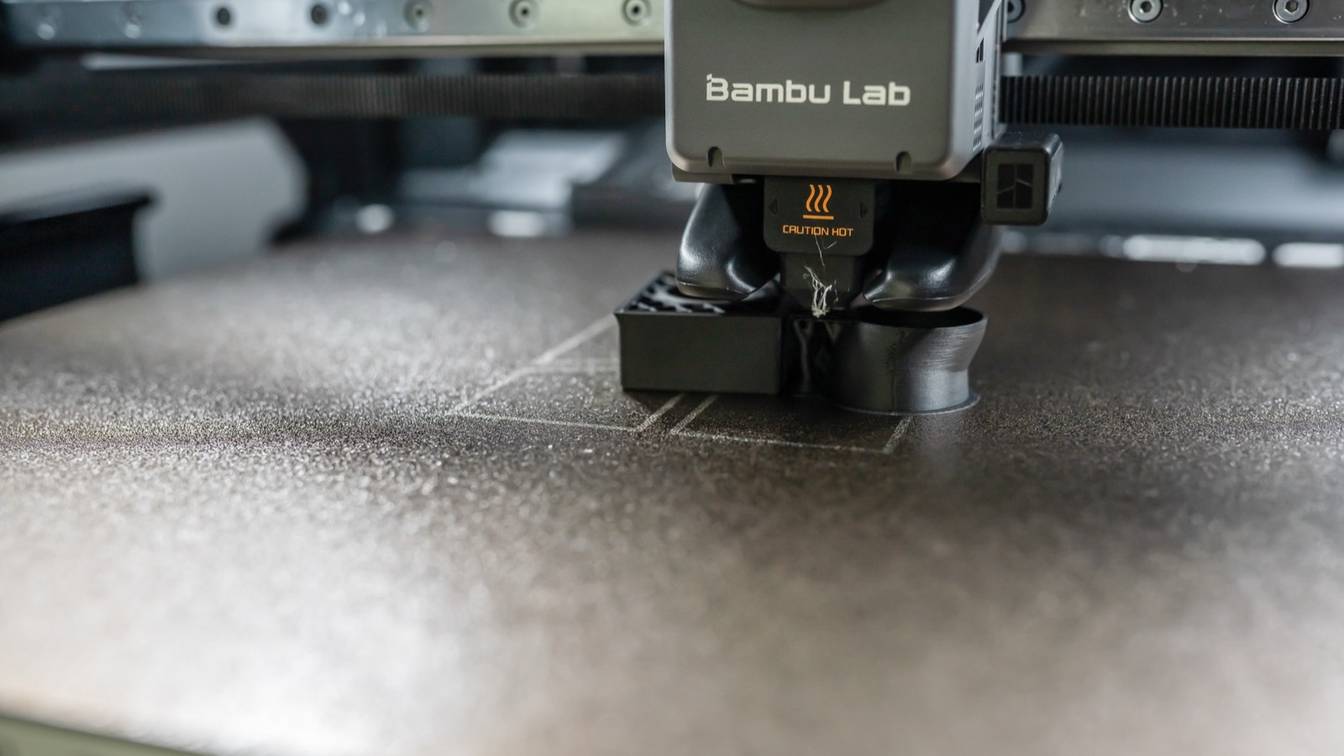

Every enclosed Bambu Lab printer can print nylon: the P1S, P2S, X1 Carbon, X1E, X2D, H2S, H2D, H2D Pro and H2C. All of them except the P1S ship with the hard nozzle that carbon- and glass-filled nylon requires: hardened steel, or tungsten carbide on the H2D Pro. Bambu Lab does not recommend nylon on its open-frame A1 mini, A1, A2L or P1P.
Which Bambu Lab printers can print nylon?
Bambu Lab rates every nylon grade it sells for its enclosed printers: the P1S, P2S, X1 Carbon, X1E, X2D and the H2 series. Fiber-filled grades also need a hardened nozzle, standard on all of them except the P1S. Bambu’s usage guides call PA6-CF, PA6-GF, PAHT-CF and PPA-CF not compatible with the P1P and A1 series.
| Printer | Frame, chamber heating | Stock nozzle | Unfilled PA | PAHT-CF | PA6-CF | PA6-GF | PPA-CF |
|---|---|---|---|---|---|---|---|
| A1 mini | Open, none | Stainless steel | Not recommended | Not compatible | Not compatible | Not compatible | Not compatible |
| A1 | Open, none | Stainless steel | Not recommended | Not compatible | Not compatible | Not compatible | Not compatible |
| A2L | Open, none | Stainless steel | Not recommended | Not recommended | Not recommended | Not recommended | Not recommended |
| P1P | Open, none | Stainless steel | Not recommended | Not compatible | Not compatible | Not compatible | Not compatible |
| P1S | Enclosed, none | Stainless steel | Recommended | Hardened upgrade first | Hardened upgrade first | Hardened upgrade first | Hardened upgrade first |
| P2S | Enclosed, none | Hardened steel | Recommended | Recommended | Recommended | Recommended | Recommended |
| X1 Carbon | Enclosed, none | Hardened steel | Recommended | Recommended | Recommended | Recommended | Recommended |
| X1E | Enclosed, active to 60 °C | Hardened steel | Recommended | Recommended | Recommended | Recommended | Recommended |
| X2D | Enclosed, active to 65 °C | Hardened steel | Both nozzles | Both nozzles | Main nozzle; auxiliary “highly not recommended” | Both nozzles | Main nozzle only |
| H2S | Enclosed, active to 65 °C | Hardened steel | Recommended | Recommended | Recommended | Recommended | Recommended |
| H2D | Enclosed, active to 65 °C | Hardened steel | Recommended | Recommended | Recommended | Recommended | Recommended |
| H2D Pro | Enclosed, active to 65 °C | Tungsten carbide | Recommended | Recommended | Recommended | Recommended | Recommended |
| H2C | Enclosed, active to 65 °C | Hardened steel | Recommended | Recommended | Recommended | Recommended | Recommended |
Bambu’s filament guide rates nylon by frame type, not by model: “Recommended” is its rating for enclosed printers and “Not recommended” its rating for open frames. “Not compatible” comes from Bambu’s usage guides for the four filled grades, which each read “Requires an enclosed printer; not compatible with P1P / A1 series”. Those guides do not name the A2L, so its cells carry the open-frame rating. The X2D cells come from its own compatibility guide.
Rows follow Bambu Lab’s line order, from the open A series up to the H2 series. Ratings are as published on October 24, 2026; the filament guide was last updated on October 14, 2026. PA is polyamide, the chemical name for nylon. PPA is polyphthalamide, a high-temperature polyamide, and CF and GF mark carbon- and glass-fiber fill.
What the ratings leave out:
- Open frames. Bambu’s A1 FAQ says nylon is not recommended for large or high-infill parts on the A1, but “can be used” for small, low-infill ones. The A1 mini and A2L beds stop at 80 °C, below the 90 to 110 °C bed that Bambu’s filament guide lists for nylon with glue stick. Neither has a nylon profile in Bambu Studio.
- P1S. Its stainless steel nozzle wears quickly on carbon or glass fiber, and its spec sheet lists filled filaments as “Not Recommended”. The FAQ on Bambu’s P1S store page says to do “an extruder and hotend upgrade” first: a hardened steel hotend plus hardened extruder gears. See fitting a hardened steel nozzle.
- PPA-CF on 300 °C printers. Bambu’s guide gives PPA-CF a 285 to 320 °C nozzle range, plus or minus 10 °C. The P1S, P2S, X1 Carbon and X2D stop at 300 °C. That still covers Bambu Studio’s PPA-CF profile for them, which prints at 290 °C. The X1E (320 °C) and the H2S, H2D and H2C (350 °C) reach the top of the range.
- Nozzle size. For every filled nylon, Bambu marks the 0.2 mm nozzle “Not Compatible” and the 0.4 mm high-flow nozzle “Not Recommended”, and recommends 0.6 mm.
- AMS. Bambu marks PA6-CF and PPA-CF not compatible with any AMS (Automatic Material System, Bambu’s multi-spool feeder). It lists PAHT-CF as compatible with the AMS but not the AMS lite, and PA6-GF as not compatible with the AMS lite.
Can the Bambu Lab H2D and H2S print nylon?
Yes. The H2S, H2D and H2C reach 350 °C at the nozzle and heat the chamber to 65 °C. They ship with hardened steel nozzles, and the H2D Pro with tungsten carbide.
Bambu’s H2D spec lists PA and carbon- or glass-fiber PA among supported filaments, along with PPA-CF/GF. Bambu Studio’s nylon profiles for the H2 series set the chamber to 60 °C.
Two H2-specific points for brittle grades:
- H2D. Bambu recommends printing PPA-CF on the left hotend, because the filament tube bends sharply at the right hotend when the toolhead returns to the back of the bed. PA6-CF is more flexible, Bambu says, and can use either hotend.
- H2S. Bambu Studio warns that “PPA-CF is brittle and could break in bended PTFE tube above Toolhead”. Bambu’s H2S guide has you rotate that tube one full turn before reinsertion. Feed from a sealed dry box through the rear intake.
Can the Bambu Lab X2D print nylon?
Yes, but its two nozzles differ. The X2D reaches 300 °C, heats its chamber to 65 °C and ships with hardened steel nozzles. Its FAQ lists unfilled PA for both nozzles.
For filled grades, Bambu’s X2D compatibility guide rates all four “Available” on the main nozzle in 0.4, 0.6 and 0.8 mm. On the auxiliary nozzle it allows PAHT-CF and PA6-GF, rates PA6-CF “Highly Not Recommended” and rules out PPA-CF.
Can the Bambu Lab P2S print nylon?
Yes. The P2S ships with a hardened steel nozzle and extruder gear. Bambu’s P2S FAQ lists PA, PA6-CF, PA6-GF, PAHT-CF and PPA-CF among its supported filaments.
The P2S has no chamber heater: Bambu rates it “50°C Chamber Ready”, warmed by the bed and hotend while the case recirculates its air. Its nozzle stops at 300 °C and its bed at 110 °C, the top of Bambu’s 90 to 110 °C glue-stick range for nylon.
Do you need a heated chamber to print nylon on a Bambu Lab printer?
No. Bambu Lab rates nylon for every enclosed model, including three with no chamber heater: the P1S, P2S and X1 Carbon. A heated chamber cuts warping and adds layer strength. Bambu’s data sheets ask for 45 to 60 °C for PAHT-CF, PA6-CF and PA6-GF; the PPA-CF sheet asks for 50 to 80 °C. Every grade must be dried first.
| Grade | Chamber temperature in Bambu’s data sheet | Bambu Studio default on heated models | Glass transition (data sheet) |
|---|---|---|---|
| PA6-CF | 45 to 60 °C | 60 °C | 68 °C |
| PA6-GF | 45 to 60 °C | 60 °C | 67 °C |
| PAHT-CF | 45 to 60 °C | 60 °C | 70 °C |
| PPA-CF | 50 to 80 °C | 60 °C | 85 °C |
| Unfilled PA | No Bambu data sheet | 60 °C (Generic PA profile) | Not published |
Rows are sorted alphabetically by grade. “Heated models” are the X1E, X2D and H2 series.
What each kind of printer can do:
- Active heating (X1E, X2D, H2 series). The X1E holds up to 60 °C and the others up to 65 °C, and Bambu Studio sets a 60 °C default for nylon. No Bambu Lab printer reaches the top of PPA-CF’s 50 to 80 °C range.
- Passive enclosure (P1S, P2S, X1 Carbon). Bambu Studio offers no chamber setting on these, yet Bambu printed its own PPA-CF test bars on an X1 Carbon with a 52 °C chamber. In a cold room, Bambu’s advice for the X1 Carbon and P1S is to preheat the bed at its maximum for 15 minutes before printing. It also suggests keeping infill at 50% or less and walls at six or fewer to limit shrinkage. Bambu’s X1E FAQ says the X1, X1C and P1 series do not support its chamber heating module; a third-party heater is an unsupported addition, at the owner’s risk (chamber heaters).
- Lid on. Keep the top glass cover on: Bambu’s guide answers “NO” to removing it for any nylon grade.
- Heat creep. Heat creep, filament softening above the hotend’s melt zone, can jam the nozzle. Bambu advises keeping the enclosure at least 10 °C below the filament’s glass transition. The 60 °C default sits 7 to 10 °C under the PA6 and PAHT grades’ 67 to 70 °C: short of that margin for PA6-CF and PA6-GF.
Whatever the model, Bambu marks drying “Required” for PA, PA-CF/GF and PAHT-CF/GF. Its data sheets ask for under 20% relative humidity during the print. A Bambu test shows why: wet PA6-CF dropped from 151 to 95 MPa flexural strength. Drying times and temperatures are in drying filament on Bambu printers.
Bambu also asks for a well-ventilated room or air filtration. Its X1E guide puts nylon among the high-VOC (volatile organic compound) filaments, and says that printing them 8 hours a day may mean a new carbon filter about monthly. Bambu warns that filled grades can carry microscopic barbs, so handle and sand them in cut-resistant gloves and safety goggles.
Temperatures, speeds and fan settings are in Bambu nylon settings, plate and glue choice in build plates for nylon, and nozzle jams in PA-CF clogging.
Sources
- Bambu Lab Wiki, Filament guide: printer, nozzle, AMS, build plate, glue compatibility and required parameters (accessed October 24, 2026)
- Bambu Lab Wiki, PET-CF / PPA-CF / PPS-CF / PA6 CF Carbon Fibers Filament Usage Guide (accessed October 24, 2026)
- Bambu Lab Wiki, ABS GF / PA6 GF Glass Fiber Filament Usage Guide (accessed October 24, 2026)
- Bambu Lab Wiki, ASA CF / PAHT CF Usage Guide (accessed October 24, 2026)
- Bambu Lab Wiki, X2D Filament Compatibility Guide (accessed October 24, 2026)
- Bambu Lab Wiki, X2D FAQs (accessed October 24, 2026)
- Bambu Lab Wiki, P2S FAQ (accessed October 24, 2026)
- Bambu Lab Wiki, A1 FAQ (accessed October 24, 2026)
- Bambu Lab Wiki, A1 mini FAQ (accessed October 24, 2026)
- Bambu Lab Wiki, A2L FAQs (accessed October 24, 2026)
- Bambu Lab Wiki, H2S FAQs (accessed October 24, 2026)
- Bambu Lab Wiki, H2C FAQs (accessed October 24, 2026)
- Bambu Lab Wiki, H2D Pro FAQs (accessed October 24, 2026)
- Bambu Lab Wiki, PPA/PPS-CF printing guide (H2S) (accessed October 24, 2026)
- Bambu Lab Wiki, X1E Chamber Setting Guide (accessed October 24, 2026)
- Bambu Lab Wiki, X1E FAQ (accessed October 24, 2026)
- Bambu Lab Wiki, What is heat creep? (accessed October 24, 2026)
- Bambu Lab, P1S tech specs (PDF) (accessed October 24, 2026)
- Bambu Lab, X1 Carbon tech specs (PDF) (accessed October 24, 2026)
- Bambu Lab, X1E Technical Specification (PDF) (accessed October 24, 2026)
- Bambu Lab store (EU), P1S, with P1P comparison (accessed October 24, 2026)
- Bambu Lab store (EU), P2S (accessed October 24, 2026)
- Bambu Lab store (EU), H2S (accessed October 24, 2026)
- Bambu Lab store (EU), H2D (accessed October 24, 2026)
- Bambu Lab, PAHT-CF Technical Data Sheet V3.0 (PDF) (accessed October 24, 2026)
- Bambu Lab, PA6-CF Technical Data Sheet V3.0 (PDF) (accessed October 24, 2026)
- Bambu Lab, PA6-GF Technical Data Sheet V1.0 (PDF) (accessed October 24, 2026)
- Bambu Lab, PPA-CF Technical Data Sheet V1.0 (PDF) (accessed October 24, 2026)
- Bambu Studio on GitHub, printer definitions (chamber temperature ranges) (accessed October 24, 2026)
- Bambu Studio on GitHub, Bambu Lab filament profiles (accessed October 24, 2026)