Comparison
Bambu Lab hotend upgrades by printer series
Bambu Lab hotends are sold per series: the P1S and X1C take Bambu Lab's hardened steel hotend and third-party high-flow or wear-resistant ones, and the A1, P2S, X2D and H2 series take clip-in hotends from Bambu Lab and four other makers. A hotend swap alone changes nozzle material and flow, not the temperature limit.
Edited by 3D Printeray EditorsPublished Last verified 12 min read
In this section: Bambu Lab(27)
On this page (7)
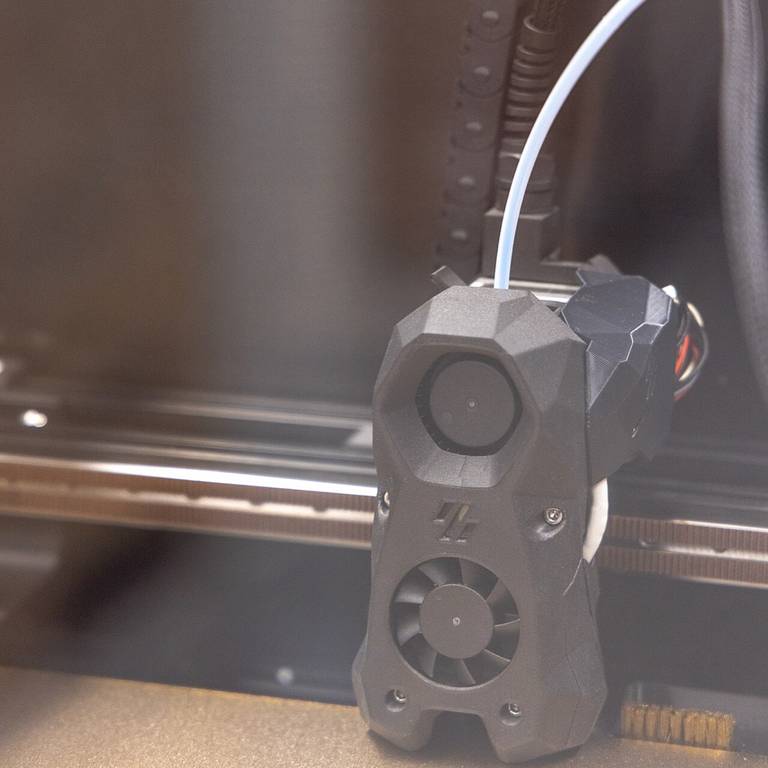

Bambu Lab hotend upgrades come from Bambu Lab, BIQU, E3D, Micro Swiss, Phaetus and Slice Engineering, sold per printer series. The X1 and P1 series (Bambu Lab P1S, X1 Carbon) take screw-in hotends with the nozzle built into the heat block, while the A1, P2S, X2D and H2 series take clip-in ones. An upgrade changes nozzle material, flow or both; the printer’s firmware still sets the temperature limit.
What hotend upgrades are available for the Bambu Lab P1S?
The Bambu Lab P1S takes Bambu Lab’s hardened steel P1 Series hotend in place of its stock stainless steel nozzle. Third-party hotends from BIQU, E3D, Micro Swiss, Phaetus and Slice Engineering add higher flow, harder nozzles or swappable nozzles. Bambu Lab makes no High Flow or tungsten carbide hotend for it, and no hotend raises its 300 °C limit.
The same designs also fit the Bambu Lab X1 Carbon (some as a separate version), so the table covers the whole X1 and P1 series. The X1 Carbon already ships with a hardened steel nozzle; its upgrade order is on the X1C upgrade path. Fitting Bambu Lab’s hardened steel hotend to a P1S is covered in hardened steel nozzles on Bambu Lab.
| Product | Fits | What it changes | Maker’s flow figure | Maker’s max temperature | Setup after fitting |
|---|---|---|---|---|---|
| Bambu Lab Hotend, P1 Series or X1C | P1P, P1S; X1C | Hardened steel nozzle in 0.4, 0.6 or 0.8 mm (stainless steel in 0.2 mm only), as a hotend or complete hotend | Not published | 320 °C hotend rating; the printers stop at 300 °C | Set the new nozzle on the printer’s screen |
| BIQU Panda Revo | X1C; P1P, P1S (separate versions) | Takes E3D RapidChange Revo nozzles, changed by hand when cold; own 60 W heater and NTC100k thermistor | 40 mm³/s (HS PLA, 260 °C, 0.4 mm Revo High Flow nozzle) | 300 °C | Wired with the harness for your model |
| E3D DiamondBack HotEnd | X1C, X1E, P1P, P1S | Polycrystalline diamond (PCD) nozzle tip for abrasive filaments; E3D says it is not a high-flow hotend | Same speed as stock (E3D) | 320 °C, on the X1E only; X1C, P1P and P1S stay at 300 °C | Bambu Studio’s standard profiles as a starting point (E3D) |
| E3D High Flow ObXidian | X1, X1C, P1P, P1S | ObXidian-coated nozzle with E3D’s internal flow modification; sold complete or reusing your heater and sensor | “60%” more than the stock hotend, no mm³/s figure | 300 °C | Raise the slicer’s volumetric flow limit; Bambu Lab publishes tuned presets |
| E3D High Flow ObXiDian 500 | X1C, P1P, P1S, X1E | ObXiDian 500 coating, which E3D rates “at least five times more wear resistant” than ObXidian | “Over 60%”, no mm³/s figure | Nozzle rated to 500 °C; limited to the printer’s 300 °C (320 °C on the X1E) | Raise the slicer’s volumetric flow limit; E3D publishes print profiles |
| Micro Swiss FlowTech | X1/X1C, P1P/P1S | Nozzles swap cold: CM2 hardened tip, brass-plated CHT, CM2 CHT or DiamondBack diamond tip; sealed heater core | Up to 50 mm³/s with a CHT nozzle; 38.4 mm³/s against 25.6 for the stock X1C hotend in Micro Swiss’s test (HT-PLA, 220 °C, 0.4 mm) | Not published | Micro Swiss advises turning off long retraction when the filament is cut |
| Phaetus Conch High-Flow Wear-Resistant Hotend | X1, X1C, X1E, P1P, P1S | EndCoat-coated nozzle (Phaetus gives HV 3300) that swaps without replacing the hotend, 0.2 to 0.8 mm | Up to 30 mm³/s (no condition stated) | Not published | Not stated |
| Phaetus Conch Hotend Plus SiC | X1, P1 | Silicon carbide nozzle and EndCoat-coated heat break; Phaetus claims up to 7 times the service life of ordinary hardened steel | Not published | Not published | Sold with or without a thermistor and ceramic heater |
| Slice Engineering Mako 65W | X1, X1C, X1E, P1P, P1S | Replaces the heater with a 65 W one; interchangeable FIN nozzles (GammaMaster or none) | 62 mm³/s (0.8 mm nozzle); Slice recommends 30 mm³/s for PLA Basic and 50 for ABS Basic at 0.4 mm | 360 °C; Slice notes Bambu Lab firmware limits the printers to 300 to 320 °C | Slice’s material profiles; Slice calls it a hotend for experienced users who tune their settings |
Rows are alphabetical by maker. Makers measure flow with different filaments, temperatures and nozzle sizes, so their figures are not directly comparable. E3D notes that a high-flow hotend prints faster only once the slicer’s volumetric flow limit is raised. Bambu Lab’s High Flow hotend compared goes further into flow.
On the X1 and P1 series the nozzle is part of the hotend, so changing nozzle size or material means changing the hotend. Since Bambu Studio V02.01.01.52, the nozzle is set on the printer, not in the slicer. The Panda Revo and Mako bring their own heater, and the Panda Revo its own thermistor. The printer’s thermal protection must match those parts, so follow the maker’s install guide and check that the hotend heats and reads temperature normally before the first print.
What hotend upgrades are available for the Bambu Lab A1?
The Bambu Lab A1 takes Bambu Lab’s clip-in A1/A2 hotends in hardened steel (0.4, 0.6 or 0.8 mm) or stainless steel. Clip-in third-party hotends from BIQU, E3D, Micro Swiss and Phaetus add high-flow, coated, silicon carbide, tungsten carbide or diamond-tipped nozzles. Bambu Lab’s High Flow hotend fits, but Bambu Lab says it adds no flow on the A1.
Each hotend in the table also fits, or comes in a version for, the A1 mini. On these printers the heater and temperature wiring stay in the toolhead when the hotend unclips, so a swap needs no rewiring. Afterward, set the nozzle on the printer under Settings > Maintenance > Nozzle. The A1 stops at 300 °C whatever is fitted.
| Product | Fits | What it changes | Maker’s flow figure | Maker’s max temperature | Setup after fitting |
|---|---|---|---|---|---|
| Bambu Lab Hotend, A1/A2 | A1, A1 mini, A2L | Hardened steel nozzle in 0.4, 0.6 or 0.8 mm, or stainless steel in 0.2 or 0.4 mm | Not published | 300 °C (Bambu Lab’s nozzle guide) | Set the nozzle on the printer |
| Bambu Lab High Flow Hotend, H2/P2S/X2D | A1 and A2 series, per Bambu Lab | Hardened steel high-flow nozzle | Bambu Lab: it “will not improve volumetric speed” on the A1/A2 series | 350 °C hotend rating; the A1 stops at 300 °C | Set the nozzle on the printer |
| E3D DiamondBack HotEnd | A1, A1 mini, A2L | PCD diamond nozzle tip for abrasive filaments | Not published | 320 °C; the printer’s limit applies | Not stated |
| E3D High Flow ObXidian | A1, A1 mini, A2L | ObXidian-coated high-flow nozzle | “Up to 70%” more; E3D says 45 mm³/s is the most an A1 or A1 mini can use with a 0.4 mm nozzle in its test, set by the printer’s 500 mm/s motion limit | Not published | Select “Hardened Steel” as the nozzle type (E3D); raise the slicer’s volumetric flow limit |
| Micro Swiss CHT High Flow Hotend | A1, A1 mini (also H2D, H2S, H2C left) | Bondtech CHT nozzle with an M2 hardened steel tip (68 HRC) and WS2 non-stick coating, 0.4, 0.6 or 0.8 mm | 36 mm³/s at 0.4 and 0.6 mm and 38 at 0.8 mm, against 24 for Bambu Lab’s standard 0.4 mm hardened steel nozzle (PLA) | Not published | Not stated |
| Micro Swiss Hyper-CHT High Flow Hotend | A1, A1 mini (also H2D, H2S, H2C left) | Hyper-CHT nozzle | “Up to 95%” more | Not published | Listed with no price and not orderable on October 30, 2026 |
| Phaetus Conch Hotend | A1, A1 mini (also H2D, H2S) | EndCoat-coated nozzle; Phaetus claims up to 2.5 times longer service life | Up to 50 mm³/s (no condition stated) | Not published | Not stated |
| Phaetus Conch Hotend M4 | A1, A1 mini | Replaceable EndCoat nozzle, 0.2 to 0.8 mm | Not published | Not published | Not stated |
| Phaetus Conch Hotend Plus SiC | A1, A1 mini | Silicon carbide nozzle, 0.4 or 0.6 mm | Not published | Not published | Not stated |
Rows are alphabetical by maker. BIQU also sells Panda Juicer hotends for the A1 and A1 mini with hardened steel, VantaC or tungsten carbide nozzles. E3D states that its A1 hotends do not void the Bambu Lab warranty because Bambu Lab approved them; for other third-party parts, see does upgrading void the warranty. The A1 mini upgrades guide covers the rest of that printer.
What hotend upgrades are available for the Bambu Lab P2S and X2D?
The Bambu Lab P2S and X2D take Bambu Lab’s High Flow and tungsten carbide hotends, shared with the H2D, H2S and H2C. Clip-in third-party hotends come from BIQU, E3D, Micro Swiss and Phaetus. Bambu Lab rates both printers’ nozzles to 300 °C, and no hotend in the table raises that limit by itself.
The H2 series runs to 350 °C, per the H2D spec sheet. The P2S ships with a hardened steel Standard Flow hotend that Bambu Lab rates at 40 mm³/s (ABS, 280 °C, single-wall model). After any swap, set the nozzle type on the printer: on the P2S, under Filament > Nozzle & Extruder > Nozzle Type.
| Product | Fits | What it changes | Maker’s flow figure | Maker’s max temperature | Setup after fitting |
|---|---|---|---|---|---|
| Bambu Lab High Flow Hotend | H2D, H2S, H2C (left), P2S, X2D | Hardened steel high-flow nozzle, 0.4, 0.6 or 0.8 mm | 65 mm³/s against 40 for the Standard Flow hotend (ABS, 280 °C, 250 mm single-wall model, H2D spec sheet) | 350 °C; the P2S and X2D stop at 300 °C | Set “High Flow” as the nozzle type on the printer |
| Bambu Lab Tungsten Carbide Hotend | H2D (both sides), H2S, H2C (left), P2S, X2D | Tungsten carbide nozzle, HRA 90 against 74 for hardened steel; Bambu Lab claims 50% longer life with abrasive fiber-filled filaments. Standard Flow or High Flow, 0.4, 0.6 or 0.8 mm | High Flow version: up to 62.5% more than Standard Flow (Bambu Lab, ABS) | 350 °C; the P2S and X2D stop at 300 °C | Set the nozzle type on the printer |
| E3D DiamondBack HotEnd | H2D, H2C, H2S, P2S, X2D, A2L | PCD diamond nozzle tip, 0.2 to 0.8 mm | Standard flow: E3D says to select “Standard” in the slicer | 350 °C; the printer’s limit applies | Select “Standard” flow |
| E3D High Flow ObXiDian 500 | H2D, H2C, H2S, P2S, X2D, A2L | ObXiDian 500-coated nozzle with a four-channel flow modification, 0.4 or 0.6 mm | “Over 60%”, no mm³/s figure | Nozzle rated to 500 °C; limited to the printer’s maximum | Select “High Flow”; raise the slicer’s volumetric flow limit |
| Micro Swiss CHT High Flow Hotend | P2S, X2D (separate version for H2D, H2S, H2C left) | Bondtech CHT nozzle, M2 hardened steel tip, WS2 coating | 36 to 38 mm³/s against 24 for Bambu Lab’s standard 0.4 mm nozzle (PLA) | Not published | Not stated |
| Micro Swiss Hyper-CHT High Flow Hotend | P2S, X2D (separate version for H2D, H2S, H2C left) | Hyper-CHT nozzle | “Up to 95%” more | Not published | Listed with no price and not orderable on October 30, 2026 |
| Phaetus Conch Hotend | H2D, H2C, H2S, X2D; separate listing for the P2S | EndCoat-coated nozzle | Up to 50 mm³/s, “25% higher flow rate” (H2D/H2C/H2S/X2D version, no condition stated) | Not published | Not stated |
| Phaetus Conch Hotend Plus SiC | P2S, X2D, H2D, H2S, H2C, A1 | Silicon carbide nozzle, 0.4 or 0.6 mm | Not published | Not published | Out of stock at Phaetus on October 30, 2026 |
| Tyson Hotend Heating Upgrade | P2S, X2D, H2S, H2D; H2C left side only | Nozzle heating, with an embedded PT100 temperature sensor | Not published | Up to 450 °C, per the maker, only when paired with a Tyson Hat and an E3D ObXidian 500 hotend; Bambu Lab rates the P2S and X2D at 300 °C and the H2 series at 350 °C | Requires a Tyson Hat, an E3D ObXidian 500 hotend and LAN-only mode. The maker states that operating a Bambu Lab printer above 300 °C is entirely at the owner’s own risk and may void the factory warranty (does upgrading void the warranty) |
Rows are alphabetical by maker. BIQU also sells Panda Juicer hotends for the P2S, X2D and H2 series, with hardened steel, VantaC or tungsten carbide nozzles. E3D gives the X2D’s limit as 350 °C, but Bambu Lab’s own X2D page lists a 300 °C nozzle.
Any row listing a temperature above the printer’s rating names the extra parts it needs. Running a Bambu Lab printer above its rated nozzle temperature is at your own risk and may void the warranty. An upgrade that replaces the heater or temperature sensor also changes what thermal protection has to watch, so whatever controls the heater must be set up for the new parts before the first heat-up.
How do you choose a hotend upgrade for a Bambu Lab printer?
Choose by what you print: abrasive filaments call for a harder nozzle and faster printing for a high-flow hotend, while anything above 300 °C depends on the printer’s limit, not the hotend.
- Carbon fiber, glass fiber or glow filament. The P1S and A1 need at least Bambu Lab’s hardened steel hotend; the X1 Carbon and P2S ship with hardened steel. Harder options on this page are tungsten carbide (Bambu Lab, H2/P2S/X2D only; BIQU for the A1, H2, P2S and X2D), silicon carbide (Phaetus), E3D’s ObXidian and ObXiDian 500 coatings, and diamond tips (E3D DiamondBack, the Micro Swiss FlowTech DiamondBack nozzle). The wear-resistant nozzle comparison sets these materials side by side.
- Faster prints. A high-flow hotend, then a higher volumetric flow limit in the slicer. Bambu Lab’s High Flow hotend is for the H2 series, P2S and X2D only; Bambu Lab lists it as not supported on the X1 and P1 series and as no faster on the A1. Owners of those printers choose among the third-party high-flow hotends above.
- Nozzle swaps without changing the hotend. The Micro Swiss FlowTech, Slice Engineering Mako, BIQU Panda Revo and Phaetus Conch High-Flow Wear-Resistant Hotend on the X1 and P1 series, and the Phaetus Conch M4 on the A1, take separate nozzles.
- Above 300 °C. No hotend swap alone gets there on the P1S, X1C, A1, P2S or X2D. Slice Engineering says the limit “is set in the firmware of the printer”, and E3D says its hotends are “restricted by the maximum printing temperature of your machine”: 300 °C on the X1C and P1S, 320 °C on the X1E. Stock, the H2 series reaches 350 °C. Firmware temperature limits explains why.
Is there an E3D Revo hotend for Bambu Lab printers?
Not from E3D. E3D’s catalog lists no Revo hotend for Bambu Lab printers, and its FAQ says the X1 and P1 High Flow ObXidian keeps the stock Bambu Lab nozzle form, so it takes no Revo nozzles. For Revo nozzles on a Bambu Lab X1C, P1P or P1S, E3D points to the BIQU Panda Revo.
The Panda Revo, which BIQU co-developed with E3D, takes every RapidChange Revo nozzle except the Revo Belt nozzle; its figures are in the X1 and P1 table. BIQU lists no Panda Revo for the A1, P2S, X2D or H2 series. BIQU’s store does list E3D’s ObXiDian 500 hotend for the H2, P2S, X2D and A2L as “E3D Revo ObXidian High Flow ObXiDian 500 HotEnd”. It describes the official E3D ObXiDian 500 High Flow hotend, the clip-in part in the P2S and X2D table, not a Revo-nozzle hotend.
How does the Bambu Lab hotend compare with the Phaetus Rapido?
They fit different printers. Phaetus sells no Rapido for any Bambu Lab printer: the Rapido 2 and Rapido 2F are listed as “DIY” hotends, and Phaetus says to match “the mount, wiring, cooling and controller sensor configuration” before fitting one. Its hotends for Bambu Lab printers are the Conch models in the tables above.
The Rapido 2F takes swappable V6-style nozzles and a PT1000 temperature sensor, and Phaetus rates it at up to 36 mm³/s. Bambu Lab rates its H2/P2S/X2D Standard Flow hotend at 40 mm³/s and its High Flow hotend at 65 mm³/s, measured in ABS on a single-wall model. The two makers use different tests, so the figures are not directly comparable.
Sources
- Bambu Lab Wiki, Introduction to Bambu Nozzles (accessed October 30, 2026)
- Bambu Lab store (EU), Bambu Hotend - P1 Series (accessed October 30, 2026)
- Bambu Lab store (EU), Bambu Hotend - X1C (accessed October 30, 2026)
- Bambu Lab store (EU), Bambu Hotend - A1/A2 (accessed October 30, 2026)
- Bambu Lab store (EU), Bambu High Flow Hotend - H2/P2S/X2D (accessed October 30, 2026)
- Bambu Lab store (EU), Tungsten Carbide Hotend - H2/P2S/X2D (accessed October 30, 2026)
- Bambu Lab store (EU), P1S (specifications) (accessed October 30, 2026)
- Bambu Lab store (EU), A1 (specifications) (accessed October 30, 2026)
- Bambu Lab store (EU), X2D (accessed October 30, 2026)
- Bambu Lab, P2S spec sheet (PDF) (accessed October 30, 2026)
- Bambu Lab, H2D spec sheet (PDF) (accessed October 30, 2026)
- Bambu Lab Wiki, Complete Hotend Assembly and Related Components Replacement Guide for P1 Series (accessed October 30, 2026)
- Bambu Lab Wiki, Hotend Replacement for A1 Series (accessed October 30, 2026)
- Bambu Lab Wiki, P2S hotend and hotend silicone sock replacement (accessed October 30, 2026)
- Bambu Lab Wiki, Manually Adjust System to E3D HF ObXidian 0.4/0.6mm Preset (accessed October 30, 2026)
- BIQU, Panda Revo Hotend for Bambu Lab P1S/P1P/X1C (accessed October 30, 2026)
- BIGTREETECH Wiki, Panda Revo X1 Hotend (accessed October 30, 2026)
- BIQU, Panda Juicer S-WC Tungsten Carbide Hotend for Bambu Lab H2D/H2S/H2C/A1/A1 mini/A2L/P2S/X2D (accessed October 30, 2026)
- BIQU, Panda Juicer Hotend High Flow for Bambu Lab (accessed October 30, 2026)
- BIQU, Panda Juicer Hotend Standard Flow for Bambu Lab (accessed October 30, 2026)
- BIQU, E3D Revo ObXidian High Flow ObXiDian 500 HotEnd for Bambu Lab H2, P2, X2 & A2 (accessed October 30, 2026)
- E3D, High Flow ObXidian Complete HotEnd for Bambu Lab X1 & P1 (accessed October 30, 2026)
- E3D, High Flow ObXidian HotEnd With Nozzle for Bambu Lab X1 & P1 (accessed October 30, 2026)
- E3D, High Flow ObXiDian 500 Complete HotEnd for Bambu Lab X1 & P1 (accessed October 30, 2026)
- E3D, High Flow ObXiDian 500 HotEnd for Bambu Lab H2, P2, X2 & A2 (accessed October 30, 2026)
- E3D, DiamondBack HotEnd for Bambu Lab X1C, X1E, P1P & P1S (accessed October 30, 2026)
- E3D, DiamondBack HotEnd for Bambu Lab A1, A1 Mini & A2L (accessed October 30, 2026)
- E3D, DiamondBack HotEnd for Bambu Lab H2, P2, X2 & A2 (accessed October 30, 2026)
- E3D, High Flow ObXidian HotEnd for Bambu Lab A1, A1 Mini & A2L (accessed October 30, 2026)
- Micro Swiss, FlowTech Hotend for Bambu Lab X1 and P1 Printers (accessed October 30, 2026)
- Micro Swiss, FlowTech for Bambu Lab: Volumetric Flow Rate Analysis (PDF) (accessed October 30, 2026)
- Micro Swiss, Tips for successful printing with FlowTech Hotend (PDF) (accessed October 30, 2026)
- Micro Swiss, CHT High Flow Hotend for Bambu Lab A1, H2, X2, P2 (accessed October 30, 2026)
- Micro Swiss, Hyper-CHT High Flow Hotend for Bambu Lab A1, H2, X2, P2 (accessed October 30, 2026)
- Phaetus, Conch High-Flow Wear-Resistant Hotend for Bambu Lab X1/P1 series (accessed October 30, 2026)
- Phaetus, Conch Hotend Plus SiC High-Flow Hotend for Bambu Lab X1 / P1 Series (accessed October 30, 2026)
- Phaetus, Conch Hotend M4 for Bambu Lab A1 & A1 mini (accessed October 30, 2026)
- Phaetus, Conch Hotend Plus SiC for Bambu Lab A1 / A1 Mini (accessed October 30, 2026)
- Phaetus, Conch Hotend for Bambu Lab H2D, H2S, A1 & A1 mini (accessed October 30, 2026)
- Phaetus, Conch Hotend for Bambu Lab H2D/H2C/H2S/X2D (US) (accessed October 30, 2026)
- Phaetus, Conch Hotend for Bambu Lab P2S, A1, A1 mini & X2D (accessed October 30, 2026)
- Phaetus, Conch Hotend Plus SiC Hotend for Bambu Lab P2S, X2D, H2D, H2S, H2C & A1 (accessed October 30, 2026)
- Phaetus, Rapido 2F Ultra-High-Flow DIY Hotend (accessed October 30, 2026)
- Phaetus, Rapido Hotend 2 High-Flow DIY Hotend (accessed October 30, 2026)
- Slice Engineering, Mako 65W High-Power Hotend for Bambu Lab (accessed October 30, 2026)
- Tyson Build, 450°C Tyson Hotend Heating Upgrade for Bambu Lab printers (accessed October 30, 2026)