Guide
Can the Bambu Lab A1 print nylon, PC, ABS or ASA?
Bambu Lab rates nylon, polycarbonate, ABS and ASA Not Recommended on the A1 and allows them only for small, low-infill parts. The open frame is what limits it, and Bambu Lab does not recommend enclosing the printer.
Published Last verified 7 min read
In this section: Bambu Lab(24)
On this page (6)
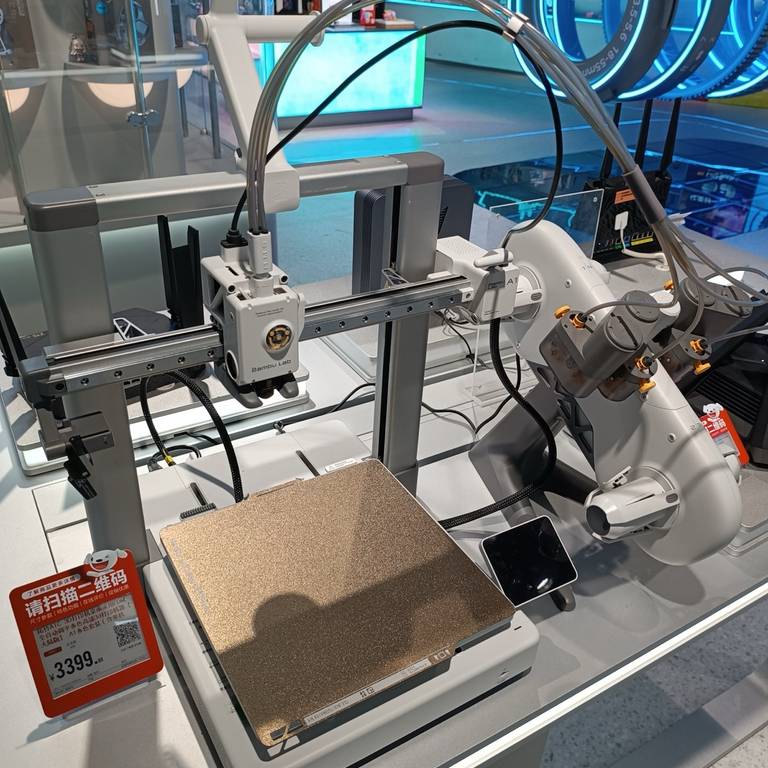

The Bambu Lab A1 can print nylon, polycarbonate (PC), ABS and ASA, but only as small parts with low infill. Bambu Lab rates all four “Not Recommended” on the A1.
The A1’s 300 °C nozzle is hot enough for all four, apart from the hottest nylon, PPA (polyphthalamide). Its 100 °C bed covers ABS and ASA but only the bottom of the PC and nylon range. The open frame is the real limit: large or dense parts warp and split between layers without a warm chamber.
Which engineering filaments does Bambu Lab support on the A1?
Bambu Lab lists PLA, PETG, TPU and PVA as “Ideal” on the A1. It marks ABS, ASA, PC, PA (nylon), PET and carbon- or glass-fiber-reinforced polymers (the CF and GF grades) “Not Recommended”. The A1 FAQ adds that these materials “can be used on A1 for printing small-sized models with low infill densities”, but not for large or dense parts that need layer strength.
The FAQ gives the reason: “Due to its open-frame design and lower chamber temperature, A1 is prone to reduced interlayer strength when using high-temperature filaments.” Bambu Lab’s filament guide says ABS, ASA, PC and PA “require higher heatbed and chamber temperatures to suppress warping and layer separation”. The guide points these materials to enclosed printers.
Ranges in the table are from Bambu Lab’s filament guide for the Bambu Textured PEI Plate, except the unfilled nylon nozzle range, which is from Bambu Studio’s Generic PA preset.
| Material | Bambu Lab’s rating on the A1 | What limits it on the A1 | What would change it |
|---|---|---|---|
| ABS, ASA | “Not Recommended”. Bambu Lab’s ABS and ASA pages: “Enclosure Printers Required” | Nozzle 240 to 280 °C and bed 90 to 100 °C both fit. No warm chamber, so large or dense parts warp. Fumes, with no filtration | Keep parts small and infill low, or use an enclosed printer |
| PA (unfilled nylon) | “Not Recommended” | Nozzle 240 to 280 °C fits. Bed 100 to 120 °C, and the A1 stops at 100 °C. No warm chamber. Must stay dry while printing | An enclosed printer with a bed above 100 °C |
| PC | “Not Recommended”. Bambu PC page: “Not compatible with A Series Printers” | Nozzle 260 to 290 °C fits. Bed 100 to 120 °C, and the A1 stops at 100 °C. No warm chamber | An enclosed printer with a bed above 100 °C |
| PA-CF/GF, PA6-CF/GF, PAHT-CF/GF | “Not Recommended”. Bambu PAHT-CF page: “unsuitable for use with open-frame printers” | As unfilled PA, with a nozzle range of 260 to 300 °C. The stock stainless steel nozzle wears out | A hardened steel nozzle stops the wear only. Warping still needs an enclosed printer |
| PPA-CF/GF | “Not Recommended” | Nozzle 285 to 320 °C, above the A1’s 300 °C | A printer whose nozzle goes past 300 °C |
The slicer does not block these materials: Bambu Studio still ships A1 presets for Bambu ABS, ASA, PC, PAHT-CF and PA6-CF. The Bambu ABS and Bambu PC presets set the bed to 100 °C, the printer’s maximum, where the base presets use 90 °C and 110 °C. On an A1 Combo, feed these spools from the external holder: Bambu Lab’s ABS, ASA, PC and PAHT-CF pages mark the AMS lite “NOT Compatible”.
The A1 FAQ says ABS and ASA “release harmful and irritating gases during printing”, and Bambu Lab’s ABS and ASA pages name styrene among them. Because the A1 has no “air-tight sealing or purification capabilities”, Bambu Lab recommends against printing them “unless in well-ventilated environments at a safe distance from people”. Anywhere else, it is at your own risk.
Can the Bambu Lab A1 print nylon?
Yes, but only small, low-infill parts. Bambu Lab rates nylon (PA) and its fiber-filled grades “Not Recommended” on the A1, and calls Bambu PAHT-CF “unsuitable for use with open-frame printers”. Nylon wants a 100 to 120 °C bed, and the A1 stops at 100 °C. Fiber-filled nylon also needs a hardened steel nozzle.
- Bed. The filament guide gives PA and its fiber grades 100 to 120 °C on Bambu Lab’s PEI and Engineering plates, so the A1’s 100 °C is the bottom of the range. The guide’s glue-stick table gives 90 to 110 °C, so on a glue-coated plate the A1’s 100 °C sits mid-range.
- Nozzle. Fiber-filled nylons such as Bambu PAHT-CF, PA6-CF and PA6-GF need hardened steel, and the A1 ships with stainless steel. Bambu Studio’s PAHT-CF and PA6-CF presets ask for a nozzle hardness of HRC 40 on the Rockwell C scale, above stainless steel’s HRC 20. Its Generic PA preset for unfilled nylon asks for HRC 3, so unfilled nylon runs on the stock nozzle. The A1’s extruder gear is already hardened steel, so the hotend is the only part to change.
- Moisture. Bambu Lab marks drying “Required” for PA and its fiber grades: 80 °C for 8 to 12 hours. It wants the spool kept with desiccant while printing. Its carbon fiber usage guide shows why: Bambu PA6-CF’s flexural strength falls from 151 MPa dry to 95 MPa when humid.
Bambu Lab’s documents disagree on fiber nylons. The same usage guide calls PA6-CF and PPA-CF “not compatible with P1P / A1 series”. Yet Bambu Studio has an A1 preset for Bambu PA6-CF, and the A1 FAQ lists PA-CF/GF among the filaments the A1 can print. For the Bambu Lab models that meet nylon’s needs, see Bambu Lab printers for nylon.
Can the Bambu Lab A1 print polycarbonate?
Yes, but only small, low-infill parts. Bambu Lab rules out even that for its own PC filament. It rates PC “Not Recommended” on the A1, and the Bambu PC product page says “Not compatible with A Series Printers”. PC needs a 100 to 120 °C bed, and the A1 stops at 100 °C, the bottom of that range.
The nozzle is not the problem: PC prints at 260 to 290 °C and needs no hardened nozzle. The limits are the bed and the chamber. The X1E heats its chamber to 60 °C by default for PC, which Bambu Lab says reduces warping and raises interlayer strength on some prints. The A1 runs in room air, and Bambu Lab’s recommended room temperature for it is 10 to 30 °C.
PC must also be dried at 80 °C for 8 hours and kept with desiccant while printing. For the Bambu Lab models that meet PC’s needs, see Bambu Lab printers for polycarbonate.
Does an enclosure let the Bambu Lab A1 print ASA and ABS?
Bambu Lab advises against it: its A1 FAQ says “We don’t recommend enclosing the A1.” An enclosure blocks drafts and keeps some bed heat around the part, which helps ABS and ASA warp less. Bambu Lab’s answer for both is an enclosed printer, or small, low-infill parts on the open A1 in a well-ventilated room.
What an enclosure changes:
- Drafts. Room air stops moving across the part. Bambu Lab blames the A1’s weak layers on its “open-frame design and lower chamber temperature”.
- Air temperature. Bed heat stays in the box. Bambu Lab says raising the bed temperature “indirectly raises the chamber temperature” on its enclosed printers, but publishes no figure for an enclosed A1. For the X1E’s heated chamber, it suggests 60 °C for large, dense or high-strength ABS and ASA parts.
- Fumes. A box with an exhaust duct or filter gives ABS and ASA fumes somewhere to go. The bare A1 has nothing.
An enclosure does not raise the 100 °C bed, so PC and nylon stay at the bottom of their range. Nor does it lift the 300 °C nozzle limit, which belongs to the printer, not the hotend. Bambu Lab builds active chamber heating into models such as the X1E and H2 series; an enclosed A1 still has none.
Bambu Lab gives no reason for its advice. Its FAQ does state two facts worth weighing before you enclose an A1: the recommended room temperature is 10 to 30 °C (50 to 86 °F), and the mainboard has no cooling fan, only a heat sink in contact with the aluminum frame. An enclosure warms the air around the whole printer, mainboard included.
Bambu Lab’s A1 documents say nothing about enclosures and the warranty. For how its policy treats third-party accessories, see does upgrading void the warranty.
Before fitting a third-party enclosure
Fitting one goes against Bambu Lab’s stated advice and is at the owner’s risk. Third-party A1 enclosures range from fabric tents to acrylic or polycarbonate panel boxes on aluminum frames, plus printable frames shared on MakerWorld. Whichever type, check three things:
- Bed travel. The A1’s bed moves front to back. Bambu Lab says to leave about 695 mm in the Y direction, plus room behind the bed for the heatbed cable.
- AMS lite space. Bambu Lab’s recommended gap between the A1 and an AMS lite is 50 mm.
- Exhaust. For ABS and ASA, fumes need a route out of the room.
What tough filaments can the Bambu Lab A1 print?
PETG and TPU, which Bambu Lab rates “Ideal” on the A1. A hardened steel nozzle adds PLA-CF, PLA-GF, PETG-CF and PETG-GF. The A1 spec table lists fiber-reinforced polymers as “Not Recommended”, but the A1 FAQ says these four print on the A1 with that nozzle, and the filament guide marks them compatible with open-frame printers. Fitting a hardened steel nozzle covers the swap.
For PETG and PETG-CF, the filament guide still recommends an enclosed printer “to prevent low ambient temperatures from reducing the model’s interlayer strength”.
Sources
- Bambu Lab Wiki, A1 FAQ (accessed October 24, 2026)
- Bambu Lab EU store, Bambu Lab A1 (specifications and FAQ) (accessed October 24, 2026)
- Bambu Lab Wiki, Filament guide: printer, nozzle, AMS, build plate, glue compatibility and required parameters (accessed October 24, 2026)
- Bambu Lab Wiki, PET-CF / PPA-CF / PPS-CF / PA6-CF carbon fiber filament usage guide (accessed October 24, 2026)
- Bambu Lab Wiki, Bambu Studio chamber temperature setting (accessed October 24, 2026)
- Bambu Lab EU store, ABS (accessed October 24, 2026)
- Bambu Lab EU store, ASA (accessed October 24, 2026)
- Bambu Lab EU store, PC (accessed October 24, 2026)
- Bambu Lab EU store, PAHT-CF (accessed October 24, 2026)
- Bambu Studio source (GitHub), BBL filament profiles (A1 presets for ABS, ASA, PC, PAHT-CF, PA6-CF and Generic PA) (accessed October 24, 2026)
- Bambu Studio source (GitHub), Bambu PC @BBL A1.json (accessed October 24, 2026)
- Bambu Studio source (GitHub), fdm_filament_pc.json (accessed October 24, 2026)
- Bambu Studio source (GitHub), Bambu ABS @BBL A1.json (accessed October 24, 2026)
- Bambu Studio source (GitHub), fdm_filament_abs.json (accessed October 24, 2026)
- Bambu Studio source (GitHub), Generic PA @base.json (accessed October 24, 2026)
- Bambu Studio source (GitHub), fdm_filament_pa.json (accessed October 24, 2026)
- Bambu Studio source (GitHub), resources/info/nozzle_info.json (accessed October 24, 2026)