Comparison
Bambu Lab X1E vs X1C for engineering materials
The Bambu Lab X1E is an X1 Carbon with a 320 °C nozzle limit instead of 300 °C, active chamber heating to 60 °C and a HEPA filter. Bambu Lab rates both for ABS, ASA, PC and carbon-filled nylon, and lists PPS-CF for the X1E only.
Published Last verified 7 min read
In this section: Bambu Lab(24)
On this page (6)
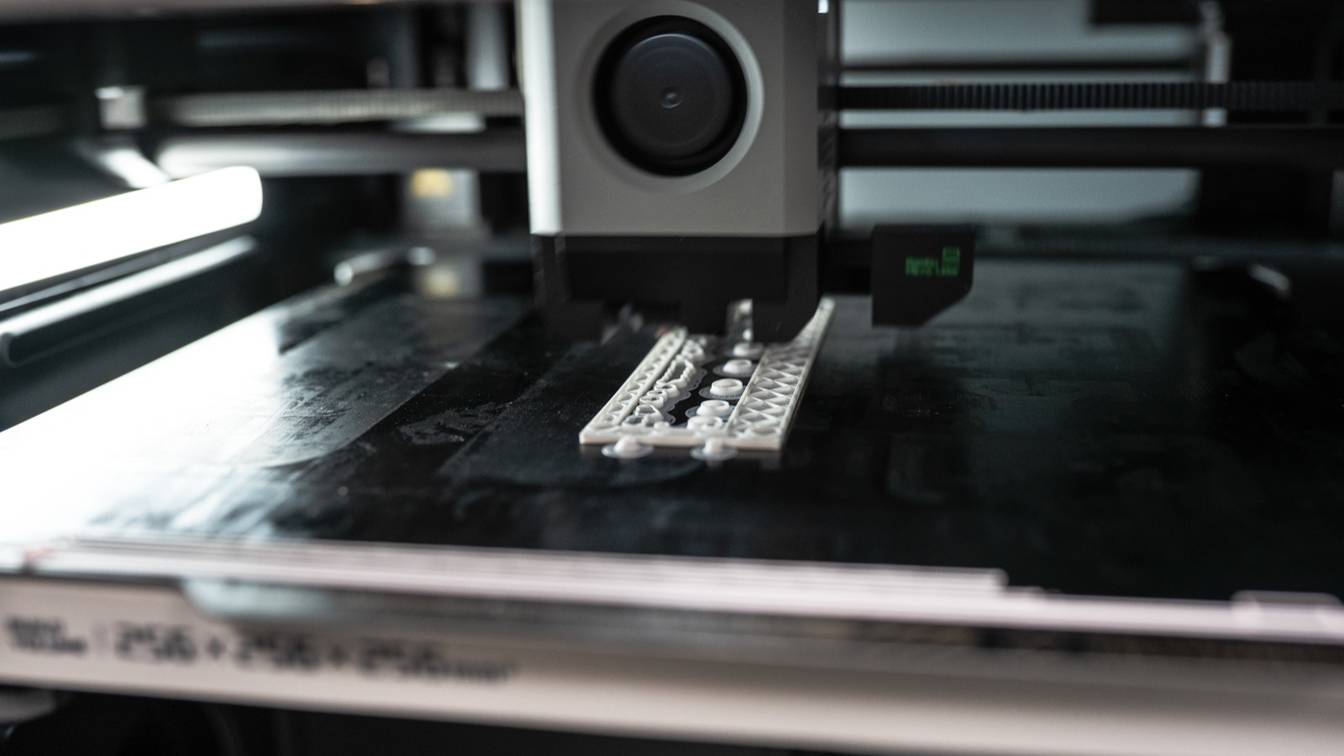

The Bambu Lab X1E is the Bambu Lab X1 Carbon (X1C) with three additions that change what it prints: a 320 °C nozzle limit instead of 300 °C, active chamber heating to 60 °C, and HEPA filtration. Bambu Lab rates both for ABS, ASA, PC and carbon-filled nylons. Only the X1E is listed for PPS-CF (carbon-fiber polyphenylene sulfide) and reaches the top of the nozzle range for PPA-CF (carbon-fiber polyphthalamide).
What is the difference between the Bambu Lab X1E and X1C for engineering materials?
The Bambu Lab X1E runs its nozzle to 320 °C, 20 °C above the X1C. It also adds two things the X1C lacks: chamber heating to 60 °C, and G3 plus H12 HEPA filtration alongside the activated carbon filter. The hardened steel nozzle and gears, the bed limits and the build volume are identical.
Side by side, from Bambu Lab’s spec sheets and end-of-life post, with launch prices from press coverage:
| Spec | Bambu Lab X1 Carbon | Bambu Lab X1E |
|---|---|---|
| Max nozzle temperature | 300 °C | 320 °C |
| Hot end, nozzle, extruder gears | All-metal; hardened steel nozzle (0.4 mm included) and gears | All-metal; hardened steel nozzle (0.4 mm included) and gears |
| Max bed temperature | 110 °C at 220 V, 120 °C at 110 V | 110 °C at 220 V, 120 °C at 110 V |
| Active chamber heating | None | Up to 60 °C, from a 380 W module |
| Air filtration | Activated carbon filter | G3 pre-filter, H12 HEPA filter, coconut-shell activated carbon |
| Max power | 1,000 W at 220 V, 350 W at 110 V | 1,400 W at 220 V, 750 W at 110 V |
| Network | Wi-Fi | Wi-Fi and 100 Mbps Ethernet, kill switch for both, removable network module, 802.1X |
| Price | $1,449 with AMS, per Make in August 2023 | $2,499 before tax at launch in October 2023, through resellers, per 3D Printing Industry |
| Production | Ended March 31, 2026 | Ended March 31, 2026 |
The spec sheets’ filament lists show the gap. The X1 Carbon sheet rates PA (nylon), PC and fiber-reinforced polymers as “Ideal”. The X1E sheet adds a line missing from the X1C’s: “PPA-CF/GF, PPS, PPS-CF/GF: Ideal”.
The filtration difference matters most for ABS, ASA and nylon fumes. Bambu Lab’s X1E chamber guide says a hot chamber lowers how much the activated carbon can absorb. That is why Bambu Lab leaves the heater off by default for ABS and ASA.
The guide puts carbon-filter life at about one month for ABS, PETG, PA and their fiber-filled grades, at 8 hours of printing a day. Even with HEPA, Bambu Lab says the X1E “should still be used in a well-ventilated place”.
Which engineering filaments can the X1E and X1C print?
Both print ABS, ASA, PC, PET-CF, PPA-CF and the filled nylons, which Bambu Lab’s filament guide marks “Recommended” for enclosed printers such as the X1 series. PPS-CF/GF is X1E-only: the guide lists it as “H2 Series and X1E Compatible; Not applicable to other models”. Beyond that, the nozzle limit sets how much of each material’s temperature range a printer can use. CF means carbon fiber and GF glass fiber.
| Material | Nozzle range (Bambu Lab, ±10 °C) | Bambu Lab X1 Carbon (300 °C) | Bambu Lab X1E (320 °C) | X1E chamber setting (Bambu Lab) |
|---|---|---|---|---|
| ABS, ASA | 240 to 280 °C | Full range | Full range | Off by default; 60 °C for large, dense or warp-prone prints |
| PC | 260 to 290 °C | Full range | Full range | 60 °C, on by default |
| PA-CF/GF, PA6-CF/GF, PAHT-CF/GF | 260 to 300 °C | Full range | Full range | 60 °C, on by default |
| PET-CF/GF | 260 to 300 °C | Full range | Full range | 60 °C, on by default |
| PPA-CF/GF | 285 to 320 °C | Up to 300 °C; Bambu Studio’s X1C preset for Bambu PPA-CF prints at 290 °C | Full range | 60 °C, on by default |
| PPS-CF/GF | 310 to 340 °C | Not listed | Up to 320 °C; Bambu Studio’s preset for Bambu PPS-CF prints at 320 °C | 60 °C, on by default |
Both printers ship with the hardened steel nozzle that Bambu Lab requires for every fiber-filled grade. Each bed stops at 110 °C on 220 V mains, so PC’s 100 to 120 °C bed range limits the two printers equally. Bambu Studio’s PC presets set 110 °C on the X1C and X1E alike.
The chamber is where they part. Bambu Lab’s PPS-CF listing recommends a 60 to 90 °C chamber, and the X1E stops at the bottom of that range. Without a heater, the X1C’s chamber is warmed only by the bed and the hotend.
What nylon can the Bambu Lab X1E print?
The X1E prints every nylon grade in Bambu Lab’s filament guide: plain PA, PA-CF/GF, PA6-CF/GF and PAHT-CF/GF. It also prints the polyphthalamide PPA-CF/GF at up to 320 °C, the top of its range. For all of them, Bambu Lab’s X1E chamber guide sets the heater to 60 °C by default.
Bambu Studio’s X1E presets for the nylons, sorted by nozzle temperature:
| Bambu Studio preset | Nozzle | Bed (Textured or Smooth PEI plate) | X1E chamber |
|---|---|---|---|
| Generic PA | 260 °C | 100 °C | 60 °C |
| Bambu PA6-GF | 265 °C | 100 °C | 60 °C |
| Bambu PA6-CF | 275 °C | 100 °C | 60 °C |
| Bambu PAHT-CF | 290 °C | 100 °C | 60 °C |
| Generic PA-CF | 290 °C | 100 °C | 60 °C |
| Bambu PPA-CF | 290 °C | 100 °C | 60 °C |
What else Bambu Lab asks for with nylon on the X1E:
- Dry it first. The filament guide lists drying as “Required” for PA and the filled nylons: 80 °C for 8 to 12 hours in a drying oven. Keep the spool with desiccant while it prints.
- Use glue stick. Bambu Lab specifies its glue stick for PA6-CF, PA6-GF, PAHT-CF and PPA-CF.
- Check the feed path. Bambu Lab’s listings mark PA6-CF and PPA-CF as not compatible with any AMS (Bambu Lab’s automatic material system). Bambu PAHT-CF works in the AMS, AMS 2 Pro and AMS HT, but not the AMS lite.
- Plan supports for a hot chamber. In a multi-material print the X1E runs the chamber at the highest setting among the loaded filaments. Above 45 °C it will not load PLA, PETG or TPU. Bambu Lab’s filament guide lists a Support for PA/PET material, printed at 260 to 300 °C.
Speeds, cooling and the other nylon presets are in the Bambu nylon settings guide.
Can an upgraded X1C match the X1E?
Only in part. Bambu Lab states that the X1C cannot be upgraded to an X1E with accessories and supports neither the X1E’s chamber heating module nor its hotend assembly. A third-party heater can warm the chamber to about 60 °C, but the 300 °C nozzle limit stays, so PPS-CF remains out of reach.
Bambu Lab’s X1E FAQ is explicit: “the X1C can not be upgraded to X1E using accessories. The X1 and X1C printers do not support the installation of the chamber heating module and the wired network module.” It adds that they “do not support installing the hotend assembly of the X1E (including the heater, NTC, and thermal grease).”
What an X1C owner can and cannot change, part by part:
- Nozzle limit: stays at 300 °C. A third-party hotend does not raise it. E3D rates its DiamondBack hotend to 320 °C but notes that “the following machines are temperature limited to 300°C P1P/P1S/X1C”. It sells a separate X1E version.
- Chamber heat: third-party kits only. BIQU sells its Panda Breath for the X1C with a 300 W PTC (positive temperature coefficient) heater and “smart chamber heating up to 60°C”. That matches the 60 °C Bambu Lab sets on the X1E for PC and the filled nylons, all of which print within 300 °C. The X1C chamber heater comparison lists the other kits sold for the X1C.
- Filtration: from add-ons. The Panda Breath, for example, also carries HEPA and activated carbon filters.
- Ethernet: not supported, per the same FAQ.
A chamber heater on an X1C is an addition Bambu Lab says the printer does not support, so fitting one is at the owner’s risk. Whether upgrading voids the warranty sets out what Bambu Lab’s policy excludes.
Heat is also a risk for soft filaments. Bambu Lab’s X1E guide warns that a hot chamber can make PLA, PETG and TPU “soften and become lodged in the extruder”. The X1E guards against this by capping its heater below 45 °C while one of them is in the hotend.
Are the X1E and X1C still sold and supported?
Bambu Lab stopped making both on March 31, 2026, and still supports them. Its end-of-life post gives the same dates for each:
- Firmware and software bug fixes and feature updates: until May 31, 2027.
- Security patches: until May 31, 2029.
- Spare parts and support: until March 31, 2031, though Bambu Lab warns some parts “may sell out earlier”.
Bambu Lab says some authorized distributors may still hold new units “covered by full warranty and support”. On October 24, 2026, its EU store sold a refurbished X1C from €549, “backed by the same official warranty as a brand-new product”. The same store listed the X1E as “available exclusively through our authorized resellers”. A printer bought in late October 2026 gets about seven months of feature updates before the May 31, 2027 cutoff.
Sources
- Bambu Lab, X1E Technical Specification (PDF) (accessed October 24, 2026)
- Bambu Lab, X1 Carbon tech specs (PDF) (accessed October 24, 2026)
- Bambu Lab Wiki, X1E FAQ (accessed October 24, 2026)
- Bambu Lab Wiki, X1E chamber setting guide (accessed October 24, 2026)
- Bambu Lab Wiki, Filament guide: printer, nozzle, AMS, build plate, glue compatibility and required parameters (accessed October 24, 2026)
- Bambu Studio (GitHub), BBL filament presets (accessed October 24, 2026)
- Bambu Lab EU store, Bambu PPS-CF (accessed October 24, 2026)
- Bambu Lab EU store, Bambu PPA-CF (accessed October 24, 2026)
- Bambu Lab EU store, Bambu PA6-CF (accessed October 24, 2026)
- Bambu Lab EU store, Bambu PAHT-CF (accessed October 24, 2026)
- Bambu Lab Blog, The X1-series is EOL (March 31, 2026) (accessed October 24, 2026)
- Bambu Lab EU store, X1E (accessed October 24, 2026)
- Bambu Lab EU store, Refurbished X1C (accessed October 24, 2026)
- 3D Printing Industry, Bambu Lab launches the X1E for engineering-grade, desktop 3D printing (October 13, 2023) (accessed October 24, 2026)
- Make:, 3D Printer Review: Bambu X1 Carbon with AMS (August 23, 2023) (accessed October 24, 2026)
- E3D, DiamondBack HotEnd for Bambu Lab X1C, X1E, P1P & P1S (accessed October 24, 2026)
- BIQU, Panda Breath smart chamber heater (accessed October 24, 2026)