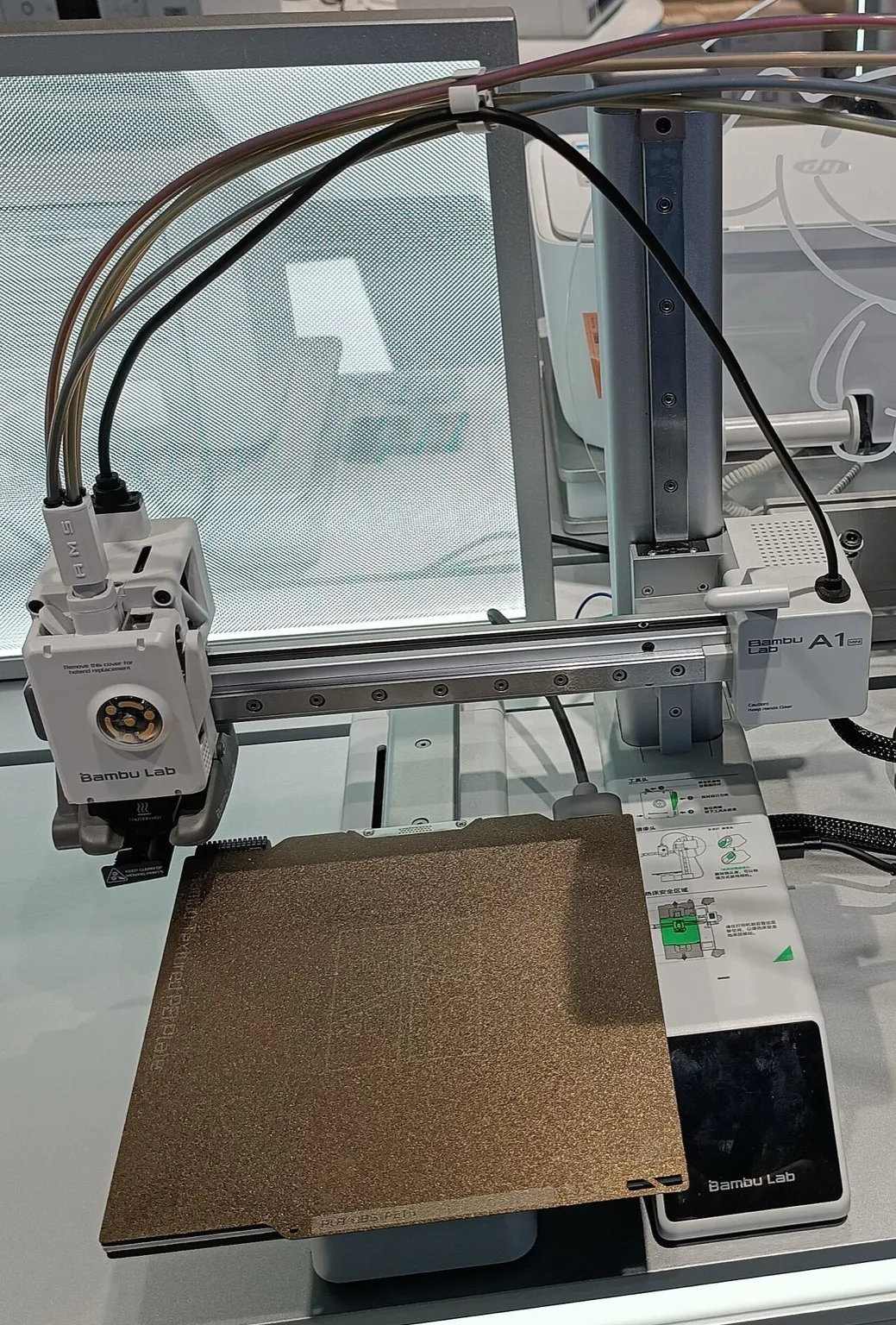
Bambu Lab A1 mini upgrades cover the hotend, the build plate and the filament feed: hardened steel or other-size hotends, three extra plate types, an AMS lite or AMS units through a hub, and third-party high-flow hotends. None of them changes the 80 °C bed, the 300 °C nozzle limit or the open frame.
The Bambu Lab A1 mini takes four kinds of upgrade: a hardened steel or different-size hotend ($11.99 each at the Bambu Lab US store), a different build plate ($11.99 to $24.99), multi-color feeding through an AMS lite or AMS unit, and third-party high-flow hotends from Micro Swiss and E3D. None of them raises the 80 °C bed or 300 °C nozzle limit. Bambu Lab does not recommend enclosing the printer, and the bed stops short of the temperatures ABS, ASA, polycarbonate (PC) and nylon (PA) need.
Which upgrades are available for the Bambu Lab A1 mini?
Bambu Lab sells A1 mini hotends in 0.2 mm stainless steel and 0.4, 0.6 and 0.8 mm hardened steel. It also sells three extra build plates, the AMS lite, and an AMS Hub for the AMS 2 Pro or AMS HT. Third-party high-flow hotends come from E3D and Micro Swiss. No upgrade raises the 80 °C bed limit.
The table runs from lowest to highest US price on October 21, 2026. Bambu Lab parts are priced at the Bambu Lab US store and the Micro Swiss hotend at the Micro Swiss store. The E3D hotend price is from West3D, a US retailer.
| Upgrade |
US price |
What it changes |
What it does not change |
| Bambu Hotend, 0.2 mm stainless steel |
$11.99 |
Finer lines for miniatures, small text and logos |
Bambu Lab lists filled filaments (carbon fiber, glass fiber, wood, marble, sparkle) and TPU as unsuited to it. Prints take longer |
| Bambu Hotend, 0.4 mm hardened steel |
$11.99 |
Resists wear from carbon- and glass-fiber PLA and PETG and from PLA Glow, which Bambu Lab says need hardened steel |
The 300 °C nozzle limit. PA-CF and PET-CF still need an enclosed printer |
| Bambu Hotend, 0.6 or 0.8 mm hardened steel |
$11.99 each |
Wider lines and faster prints for large parts. Bambu Lab names 0.6 mm hardened steel its first choice for fiber-filled filaments, for the lower clog risk |
Fine detail drops as the diameter grows |
| Bambu 3D Effect Plate (Carbon Fiber, Diamond, Galaxy or Starry) |
$11.99 |
Imprints the pattern on the first layer of PLA or TPU prints, the two filaments Bambu Lab recommends on it |
Adds no materials. Bambu Lab says to apply no glue and to set the plate type to Smooth PEI/High Temp Plate in Bambu Studio |
| Bambu Smooth PEI Plate |
$21.99 |
A smooth, matte underside. Prints PLA without glue |
Needs glue for PETG and TPU. Bambu Lab’s PEI plate pages mark ABS, ASA, PC and PA “not for A1 mini” |
| Bambu Dual-Texture PEI Plate |
$24.99 |
Textured PEI on one side, smooth PEI on the other |
Glue for PETG on the smooth side. Same “not for A1 mini” materials |
| Micro Swiss CHT High Flow Hotend, 0.4, 0.6 or 0.8 mm |
$46.95 |
Micro Swiss states a 50% increase in maximum volumetric flow |
The 300 °C limit |
| E3D High Flow ObXidian HotEnd, 0.4 or 0.6 mm |
$61.49 |
E3D states up to 70% more flow than the standard Bambu hotend, with a wear-resistant ObXidian nozzle for abrasive filaments |
The 300 °C limit. To print faster with it, E3D says to raise the slicer’s volumetric flow limit |
| AMS HT ($139) or AMS 2 Pro ($299), plus AMS Hub - A1 Series ($19.99) |
From $158.99 |
Up to four AMS units in any mix of AMS, AMS 2 Pro and AMS HT |
Cannot be mixed with an AMS lite on the same printer |
| AMS lite |
$199 |
Four spools for multi-color prints, plus automatic backup when a spool runs out |
One AMS lite per printer, so four colors at most. No TPU except Bambu’s TPU for AMS. Adding an AMS lite covers the Combo and the setup |
Choose the A1 mini variant when ordering a Bambu hotend. The heater and thermistor stay in the toolhead when the hotend unclips, so a swap needs no rewiring. Fitting a hardened steel nozzle walks through the swap, and hardened steel vs stainless steel compares the two nozzle materials.
The extruder does not need an upgrade for abrasive filaments. Bambu Lab’s parts listing says the A1-series extruder unit already uses hardened steel gears. The $9.99 hardened steel gear assembly in the store replaces worn gears.
The Micro Swiss and E3D hotends are third-party parts, though E3D describes its A1 hotend as an official collaboration with Bambu Lab. Bambu Lab’s High Flow hotend vs the third-party options compares their stated flow, and does upgrading void the warranty quotes Bambu Lab’s warranty on third-party parts.
What filaments can a stock Bambu Lab A1 mini print?
A stock Bambu Lab A1 mini prints PLA, PETG, TPU and PVA, which Bambu Lab lists as ideal. It also prints BVOH and support filaments for PLA and PETG. Carbon- and glass-fiber blends and glow-in-the-dark PLA need a hardened steel nozzle first. Bambu Lab does not recommend ABS, ASA, PC, PA or PET on the A1 mini.
“Stock” means the 0.4 mm stainless steel nozzle and textured PEI plate the printer ships with. The bed temperatures below are Bambu Lab’s ranges for that plate.
| Filament |
On a stock A1 mini |
Bambu Lab’s condition |
| PLA (Basic, Matte, Silk, Tough and other unfilled grades), PLA Metal, PLA Wood |
Yes |
Bed 45 to 65 °C. No hardened nozzle needed |
| PETG, PETG HF, PETG Translucent |
Yes |
Bed 60 to 80 °C, the top of which is the A1 mini’s maximum. The filament guide recommends an enclosed printer for PETG, to keep a cold room from weakening the layers |
| TPU |
Yes |
Bed 35 to 45 °C, fed from the external spool holder. The AMS lite does not take TPU, apart from Bambu’s TPU for AMS |
| PVA, BVOH, Support for PLA and Support for PLA/PETG |
Yes |
PVA and BVOH must be dry |
| PLA-CF and PLA-GF, PETG-CF and PETG-GF, PLA Glow |
After a hardened steel nozzle |
Bambu Lab says not to print them through stainless steel or brass |
| ABS, ASA, PC, PA, PET and their fiber-filled grades |
Not recommended |
Bambu Lab’s FAQ warns of warping, prints detaching from the bed and weak Z strength |
Bambu Lab’s documents disagree on two points. The A1 mini spec table lists carbon- and glass-fiber-reinforced polymers as “Not Recommended”. The A1 mini FAQ says that with a hardened steel nozzle “you can print CF-based filaments on the A1 mini”. The table above follows the FAQ and the filament guide, which marks PLA-CF/GF and PETG-CF/GF as compatible with open-frame printers.
The filament guide’s nozzle table also marks PLA Marble as not needing hardened steel. Its nozzle notes, however, list PLA Marble and PLA Sparkle among the particle-filled filaments that should not run through a stainless nozzle. A hardened steel hotend satisfies both readings.
Which A1 mini upgrades actually help, and are any must-haves?
None is required. Bambu Lab ships the A1 mini ready for PLA, PETG, TPU and PVA, so an upgrade helps only when you hit the limit it removes. Match the problem to the part:
| If you want to |
Upgrade that does it |
Who it applies to |
| Print carbon- or glass-fiber PLA or PETG, or glow PLA |
0.4 mm hardened steel hotend, Bambu Lab’s recommended size for its own PLA-CF and PETG-CF, or 0.6 mm for other brands’ fiber-filled filaments |
Anyone buying filled filaments. For plain PLA and PETG, Bambu Lab marks hardened steel as not required |
| Print several colors, or soluble supports, in one job |
AMS lite, or AMS units through the AMS Hub |
Multi-color and support-heavy prints. A single-color user gains automatic spool backup |
| Print large, simple parts faster |
0.6 or 0.8 mm hotend, or a high-flow hotend |
Parts where coarser lines are acceptable. A high-flow hotend needs a higher volumetric flow limit in the slicer |
| Print miniatures and small text |
0.2 mm stainless steel hotend |
Small models in unfilled PLA, PETG or PVA |
| Change the underside finish of prints |
Smooth, Dual-Texture or 3D Effect plate |
Prints with a visible bottom face. The materials list stays the same |
| Print ABS, ASA, PC or nylon |
No A1 mini upgrade |
See the next section |
Can you upgrade an A1 mini to print ABS, ASA or nylon?
No. Four A1 mini limits stay in place whatever you fit:
- Bed: 80 °C maximum. Bambu Lab’s filament guide gives 90 to 100 °C for ABS and ASA, and 100 to 120 °C for PC and PA on the textured PEI plate.
- Frame: open. Bambu Lab’s FAQ says: “We don’t recommend enclosing the A1 mini.” It gives a recommended room temperature of 10 to 30 °C (50 to 86 °F). A third-party enclosure goes against that advice and still leaves the bed at least 10 °C short of ABS’s range.
- Nozzle: 300 °C maximum. The printer sets the limit, not the hotend, so swapping hotends leaves it unchanged. Firmware temperature limits explains why.
- Build volume: 180 × 180 × 180 mm. No upgrade above makes it bigger.
For ABS, ASA, PC and nylon, Bambu Lab’s filament guide points to an enclosed printer. The Bambu Lab models page lists each model’s bed, nozzle and chamber limits.